Coral reefs are beautiful, vibrant ecosystems and a cornerstone of a healthy ocean. Often called the “rainforests of the sea,” they support an extraordinary diversity of marine life from fish and crustaceans to mollusks, sea turtles and more. Although reefs cover less than 1% of the ocean floor, they provide critical habitat for roughly 25% of all ocean species.
Coral reefs are also essential to human wellbeing. These structures reduce the force of waves before they reach shore, providing communities with vital protection from extreme weather such as hurricanes and cyclones. It is estimated that reefs safeguard hundreds of millions of people in more than 100 countries.
What is coral bleaching?
A key component of coral reefs are coral polyps—tiny soft bodied animals related to jellyfish and anemones. What we think of as coral reefs are actually colonies of hundreds to thousands of individual polyps. In hard corals, these tiny animals produce a rigid skeleton made of calcium carbonate (CaCO3). The calcium carbonate provides a hard outer structure that protects the soft parts of the coral. These hard corals are the primary building blocks of coral reefs, unlike their soft coral relatives that don’t secrete any calcium carbonate.
Coral reefs get their bright colors from tiny algae called zooxanthellae. The coral polyps themselves are transparent, and they depend on zooxanthellae for food. In return, the coral polyp provides the zooxanethellae with shelter and protection, a symbiotic relationship that keeps the greater reefs healthy and thriving.
When corals experience stress, like pollution and ocean warming, they can expel their zooxanthellae. Without the zooxanthellae, corals lose their color and turn white, a process known as coral bleaching. If bleaching continues for too long, the coral reef can starve and die.
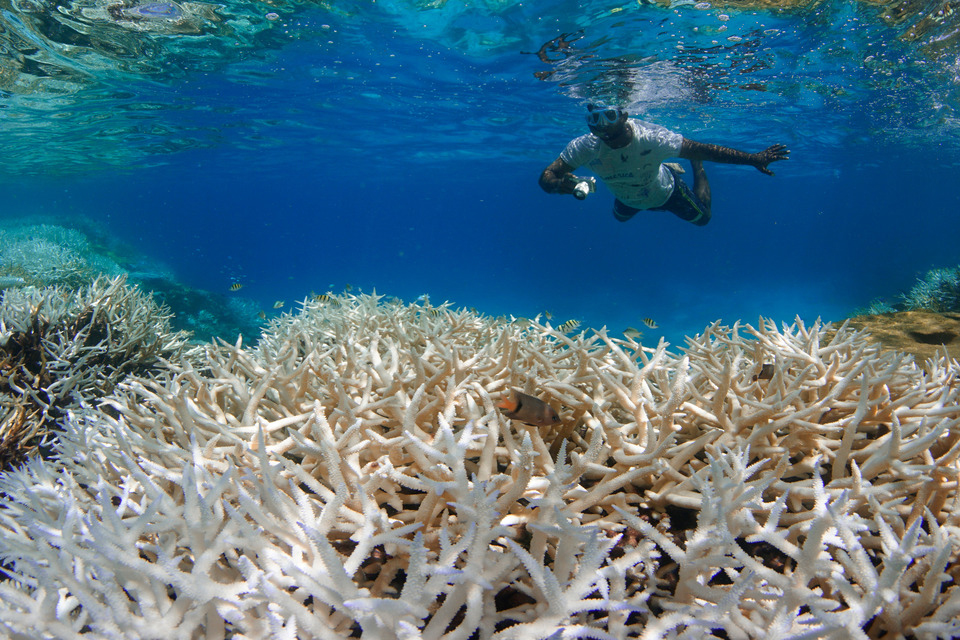
Ocean warming and coral bleaching
Human-driven stressors, especially ocean warming, threaten the long-term survival of coral reefs. An alarming 77% of the world’s reef areas are already affected by bleaching-level heat stress.
The Great Barrier Reef is a stark example of the catastrophic impacts of coral bleaching. The Great Barrier Reef is made up of 3,000 reefs and is home to thousands of species of marine life. In 2025, the Great Barrier Reef experienced its sixth mass bleaching since 2016. It should also be noted that coral bleaching events are a new thing because of ocean warming, with the first documented in 1998.
Get Ocean Updates in Your Inbox
Sign up with your email and never miss an update.
How you can help
The planet is changing rapidly, and the stakes have never been higher. The ocean has absorbed roughly 90% of the excess heat caused by anthropogenic greenhouse gas emissions, and the consequences, including coral die-offs, are already visible. With just 2℃ of planetary warming, global coral reef losses are estimated to be up to 99% — and without significant change, the world is on track for 2.8°C of warming by century’s end.
To stop coral bleaching, we need to address the climate crisis head on. A recent study from Scripps Institution of Oceanography was the first of its kind to include damage to ocean ecosystems into the economic cost of climate change – resulting in nearly a doubling in the social cost of carbon. This is the first time the ocean was considered in terms of economic harm caused by greenhouse gas emissions, despite the widespread degradation to ocean ecosystems like coral reefs and the millions of people impacted globally.
This is why Ocean Conservancy advocates for phasing out harmful offshore oil and gas and transitioning to clean ocean energy. In this endeavor, Ocean Conservancy also leads international efforts to eliminate emissions from the global shipping industry—responsible for roughly 1 billion tons of carbon dioxide every year.
But we cannot do this work without your help. We need leaders at every level to recognize that the ocean must be part of the solution to the climate crisis. Reach out to your elected officials and demand ocean-climate action now.
The post What is Coral Bleaching and Why is it Bad News for Coral Reefs? appeared first on Ocean Conservancy.
from Ocean Conservancy https://ift.tt/SsnZqbW https://ift.tt/aD5G4Mb

No comments:
Post a Comment