Tuesday, 31 March 2026

All About False Killer Whales

Despite their dramatic name, false killer whales aren’t an orca species. These animals are dolphins—members of the same extended family as the iconic “killer whale” (Orcinus orca). Compared to their namesake counterparts, these marine mammals are far less well-known than our ocean’s iconic orcas.

Let’s dive in and take a closer look at false killer whales—one of the ocean’s most social, yet lesser-known dolphin species.

Appearance and anatomy

False killer whales (Pseudorca crassidens) are among the largest members of the dolphin family (Delphinidae). Adults can grow up to 20 feet long and weigh between 1,500 and 3,000 pounds, though some individuals have been recorded weighing even more. For comparison, that’s roughly double the size of a bottlenose dolphin—and slightly larger than a typical sedan.

These animals are incredibly powerful swimmers with long, torpedo-shaped bodies that help them move efficiently through the open ocean in search of prey. Their skull structure is what earned them their name, as their head shape closely resembles that of orcas. With broad, rounded heads, muscular jaws and large cone-shaped teeth, early scientists were fascinated by the similarities between these two marine mammal species.

Although their heads may look somewhat like those of orcas, there are several ways to distinguish false killer whales from their larger namesake counterparts.

One of the most noticeable differences has to do with their coloration. While orcas are known for their iconic black-and-white pattern with paler underbellies, alternatively, false killer whales are typically a uniform dark gray to black in color—almost as if a small orca decided to roll around in the dirt. If you’ve ever seen the animated Disney classic 101 Dalmatians, the difference is a bit like when the puppies roll in soot to disguise themselves as labradors instead of showing their usual black-and-white spots.

Their teeth also present a differentiator. The scientific name Pseudorca crassidens translates almost literally to “thick-toothed false orca,” a nod to their sturdy, cone-shaped teeth that help these animals capture prey. Orcas tend to have more robust, bulbous heads, while false killer whales appear slightly narrower and more streamlined.
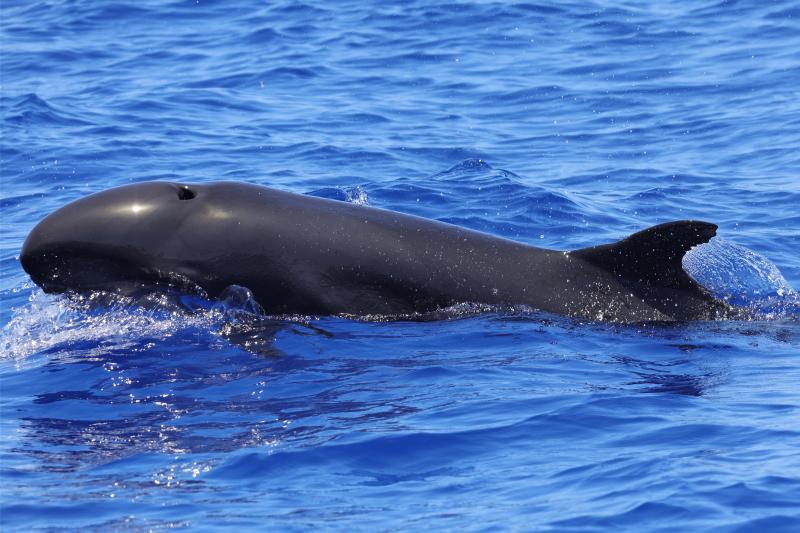
A false killer whale surfaces to breathe in incredibly blue ocean waters.

Behavior and diet

False killer whales are both highly efficient hunters and deeply social animals. It’s not unusual to see them hunting together both in small pods and larger groups as they pursue prey like fish and squid.

Scientists have even observed false killer whales sharing food with each other, a behavior that is very unusual for marine mammals. While some dolphin and whale species work together to pursue prey, they rarely actively share food. The sharing of food among false killer whales spotlights the strong social bonds within their pods. Researchers believe these tight-knit social connections help false killer whales thrive in offshore environments where they’re always on the move.

Maintaining these close bonds and coordinating successful hunts requires constant effective communication, and this is where false killer whales excel. Like other dolphins, they produce a variety of sounds like whistles and clicks to stay connected with their pod and locate prey using echolocation. In the deep offshore waters where they live, sound often becomes more important than sight, since sound travels much farther underwater than light.

Where they live

False killer whales are highly migratory and travel long distances throughout tropical and subtropical waters around the world. They prefer deeper waters far offshore, and this pelagic lifestyle can make them more difficult for scientists to study than many coastal dolphin species.

However, there are a few places where researchers have been able to learn more about them—including the waters surrounding the Hawaiian Islands.

Scientists have identified three distinct groups of false killer whales in and around Hawaii, but one well-studied group stays close to the main Hawaiian Islands year-round. Unfortunately, researchers estimate that only about 140 individuals remained in 2022, with populations expected to decline without action to protect them. This is exactly why this group is listed as endangered under the U.S. Endangered Species Act and is considered one of the most vulnerable marine mammal populations in U.S. waters.

Never Miss An Update

Sign up for Ocean Conservancy text messages today.

This field is for validation purposes and should be left unchanged.
This field is hidden when viewing the form
Name(Required)
By providing your mobile number you consent to receive recurring text messages from Ocean Conservancy from 52551 for donations to protect our ocean from today’s greatest global challenges. Message and data rates may apply. Reply HELP for more information or STOP to cancel. Terms & Conditions and Privacy Policy

This field is hidden when viewing the form
SMS Opt-in: Selected(Required)

Current threats to survival

False killer whales are currently listed as Near Threatened on the IUCN Red List. From climate change-induced ocean acidification and harmful algal blooms to marine debris and fishing bycatch, false killer whales face the same mounting pressures that are impacting marine ecosystems around the world. As their prey becomes scarce due to increasing threats, populations of top predators like these decline, serving as a powerful signal that the ocean’s overall health is in critical need of protection.

Here at Ocean Conservancy, we’re working daily to confront these threats head-on and protect the ecosystems and wildlife we all cherish so dearly. But we can’t do it without you. Support from ocean lovers is what powers our work to protect our ocean, and right now, our planet needs all the help it can get. Visit Ocean Conservancy’s Action Center today and join our movement to create a better future for our ocean, forever and for everyone.

The post All About False Killer Whales appeared first on Ocean Conservancy.


from Ocean Conservancy https://ift.tt/PuC1npM https://ift.tt/e94wc7u

Tuesday, 17 March 2026

What are Limpets and Why Do They Matter to Our Ocean?

If you’ve ever explored the shores or tidal pools of our ocean, chances are you’ve spotted some small, cone-shaped shells clinging to rocks. These are sea snails called limpets, and they are far more resilient and important than they may appear. 

To feed, limpets use a tongue-like organ called a radula. The radula is covered in rows of tiny teeth, each measuring less than a millimeter in length. The remarkable strength of limpet teeth stems from their structure, which is made of chitin—a primary material in the exoskeletons of insects and crustaceans—and reinforced by the mineral goethite. Researchers in the U.K. have found that goethite is the strongest known biological material on Earth and is even stronger than Kevlar. Limpets use their incredibly sturdy teeth and radula to scrape algae off rocks with ease, earning them the nickname the “bulldozers of the seashore.”

To move across rock formations, limpets utilize tidal movements and their strong muscular “foot.” This foot is different than a human foot in that it acts as a suction cup to firmly attach the limpet to rocks and withstand the force of waves. The foot also produces mucus, which helps with adhesion and eases movement by allowing the limpet to glide across rock formations. As limpets travel, they also leave behind a trail of this mucus, which helps guide them back to a preferred resting spot during low tide.

Over time, a limpet creates a “home scar,” a small indentation in the rock formed by repeatedly scraping and returning to the same location. During low tide, the limpet uses its foot to seal itself tightly to this home scar and prevent it from drying out. Limpets can live for more than 20 years, often remaining on the same rock their entire lives.

Get Ocean Updates in Your Inbox

Sign up with your email and never miss an update.

This field is hidden when viewing the form
Name(Required)
By providing your email address, you consent to receive emails from Ocean Conservancy.
Terms & Conditions and Privacy Policy


This field is hidden when viewing the form
Email Opt-in: Selected(Required)

Why are Limpets Important for Our Ocean?

Limpets play an essential role in controlling algae growth on the rocky surfaces of our ocean.  By clearing algae, limpets create space for other species, like barnacles and mussels, to settle and thrive. Those species, in turn, provide habitat for countless microorganisms and other marine life.

Limpets also provide a significant food source for fish, birds and even humans. In fact, the earliest known evidence of humans eating limpets dates back 164,000 years to a cave in South Africa. Today, limpets are considered a delicacy in many coastal cultures worldwide. 

Unfortunately, limpets face the same threats that affect all ocean species. Dirty fossil fuel production, oil spills and other human stressors are causing our ocean to absorb more carbon and making seawater more acidic. Limpets are particularly impacted by ocean acidification caused by a changing climate. Ocean acidification causes the calcium carbonate in the limpet shells to dissolve, making it difficult to maintain normal function, growth and reproduction.

At Ocean Conservancy, we know that a responsible and rapid transition away from oil and gas toward 100%-clean ocean energy by 2050 is both possible and essential to protect our ocean from the climate crisis. But we cannot do this work alone. Take action and demand bold ocean-climate solutions that protect limpets and all marine species. 

The post What are Limpets and Why Do They Matter to Our Ocean? appeared first on Ocean Conservancy.


from Ocean Conservancy https://ift.tt/4HJwizD https://ift.tt/nXRlpue

Monday, 9 March 2026

How NOAA Supports Abundant Fisheries

What do a school of cod in the Gulf of Maine, a humpback whale migrating down the West Coast and a coastal wetland along the Gulf Coast have in common? NOAA Fisheries, part of the National Oceanic and Atmospheric Administration (NOAA), conserves and manages these and many other ocean resources.

NOAA Fisheries—also called the National Marine Fisheries Service (NMFS)–is critically important for a healthy ocean and sustainable fisheries and provides services the American public relies on. NOAA Fisheries has a big mission: It is responsible for the stewardship of our nation’s ocean resources and their habitats.

NOAA Fisheries is a model for marine resource management around the world. Here are just some of the services that NOAA Fisheries delivers:

Keeping Fishing Sustainable

Effectively managing fisheries is what allows us to fish now and still conserve fish stocks and marine ecosystems for the future. NOAA Fisheries manages commercial and recreational fisheries in federal waters and plays a key role in management at the international and state levels. Sustainable management includes keeping catch within science-based catch limits, ending overfishing, rebuilding overfished stocks and preventing bycatch. While there is still room for improvement, NOAA Fisheries and its partners have rebuilt 52 fish stocks to healthy levels since 2000 and reduced overfishing to just 6% of stocks. Abundant fish stocks can pay dividends for commercial fishermen and anglers, for coastal communities and businesses and for the ecosystem.

Supporting Healthy Marine Ecosystems

Fish and other marine life need healthy habitats to thrive, also benefiting coastal communities and economies. NOAA Fisheries conserves and restores coastal and ocean habitats, such as wetlands and coral reefs, as well as rivers upstream. Restoration activities include removing culverts and dams that block fish passage and cleaning up after oil spills. Conserving habitats often means ensuring minimal damage to habitats from ocean activities—everything from fishing to marine construction. Through conserving habitats, NOAA Fisheries helps protect special places and ensure minimal damage to habitat from human activity.

Get Ocean Updates in Your Inbox

Sign up with your email and never miss an update.

This field is hidden when viewing the form
Name(Required)
By providing your email address, you consent to receive emails from Ocean Conservancy.
Terms & Conditions and Privacy Policy


This field is hidden when viewing the form
Email Opt-in: Selected(Required)

Supporting Coastal Communities

NOAA Fisheries works to meet the needs of local fishing communities and other coastal communities to support sustained participation in fisheries and fishing livelihoods, cultural practices and local seafood economies. Better understanding the benefits and costs of changes to the management of local fisheries helps plan for uncertainty and change, improving safety at sea and responding to fisheries disasters. 

Ensuring Safe and Sustainable Sources of Seafood

Americans rely on having access to fresh and safe seafood. NOAA Fisheries provides services to the seafood industry nationwide and abroad, including checking sanitation, inspecting fish and shellfish products, testing for contaminants, offering training and helping prepare seafood for export. When events like oil spills threaten the seafood supply, the program provides testing for safety. NOAA Fisheries also enforces laws and regulations, ensuring seafood entering the U.S. seafood supply complies with regulations that keep us safe and protect fish and other species.

Protecting Marine Mammals, Sea Turtles and Other Species

NOAA Fisheries protects and recovers marine species listed under the Endangered Species Act and conserves and manages marine mammals (whales, dolphins, porpoises, seals and sea lions) under the Marine Mammal Protection Act. It also manages sea turtles and responds to stranded and injured marine animals. NOAA Fisheries achieves these objectives in part through permitting, authorizing and consulting on activities and actions that could affect protected resources in order to limit impacts and ensure compliance with the law.

Delivering Cutting-Edge Science

NOAA Fisheries produces world-class science and research to support conservation and management decisions. This includes surveys that provide critical information about fish stocks, marine mammals and ecosystems. Some surveys are conducted on NOAA’s fleet of “white ships,” but others involve cooperative research with fishermen. NOAA Fisheries is also continually integrating cutting-edge new technologies, like uncrewed aerial systems (UAS) and Saildrones, and adopting innovative methods such as the use of environmental DNA (eDNA), which can detect the presence of animals in a body of water through water sampling.

NOAA Fisheries assessments help managers understand the status of fish stocks, including how many fish can be caught sustainably. NOAA Fisheries also produces valuable ecosystem and socioeconomic data that go into stock assessments and are considered in management decisions. For example, scientists track the development of marine heatwaves and the impacts observed in the ecosystem that can cause disruptions to fisheries.

Finally, NOAA Fisheries doesn’t function alone—it works with countless partners on science, management and conservation. From industry, state and local governments, Tribes, academic institutions, community groups and others, NOAA Fisheries touches communities throughout the nation.

The post How NOAA Supports Abundant Fisheries appeared first on Ocean Conservancy.


from Ocean Conservancy https://ift.tt/5gekyFp https://ift.tt/mt6zVil

How to Have a Plastic-Free Picnic

As the weather begins to warm across the United States, people are taking to parks and beaches once again for picnics, barbecues and other c...