Friday, 23 January 2026

What is Coral Bleaching and Why is it Bad News for Coral Reefs?

Coral reefs are beautiful, vibrant ecosystems and a cornerstone of a healthy ocean. Often called the “rainforests of the sea,” they support an extraordinary diversity of marine life from fish and crustaceans to mollusks, sea turtles and more. Although reefs cover less than 1% of the ocean floor, they provide critical habitat for roughly 25% of all ocean species.

Coral reefs are also essential to human wellbeing. These structures reduce the force of waves before they reach shore, providing communities with vital protection from extreme weather such as hurricanes and cyclones. It is estimated that reefs safeguard hundreds of millions of people in more than 100 countries. 

What is coral bleaching?

A key component of coral reefs are coral polyps—tiny soft bodied animals related to jellyfish and anemones. What we think of as coral reefs are actually colonies of hundreds to thousands of individual polyps. In hard corals, these tiny animals produce a rigid skeleton made of calcium carbonate (CaCO3). The calcium carbonate provides a hard outer structure that protects the soft parts of the coral. These hard corals are the primary building blocks of coral reefs, unlike their soft coral relatives that don’t secrete any calcium carbonate.

Coral reefs get their bright colors from tiny algae called zooxanthellae. The coral polyps themselves are transparent, and they depend on zooxanthellae for food. In return, the coral polyp provides the zooxanethellae with shelter and protection, a symbiotic relationship that keeps the greater reefs healthy and thriving.

When corals experience stress, like pollution and ocean warming, they can expel their zooxanthellae. Without the zooxanthellae, corals lose their color and turn white, a process known as coral bleaching. If bleaching continues for too long, the coral reef can starve and die.
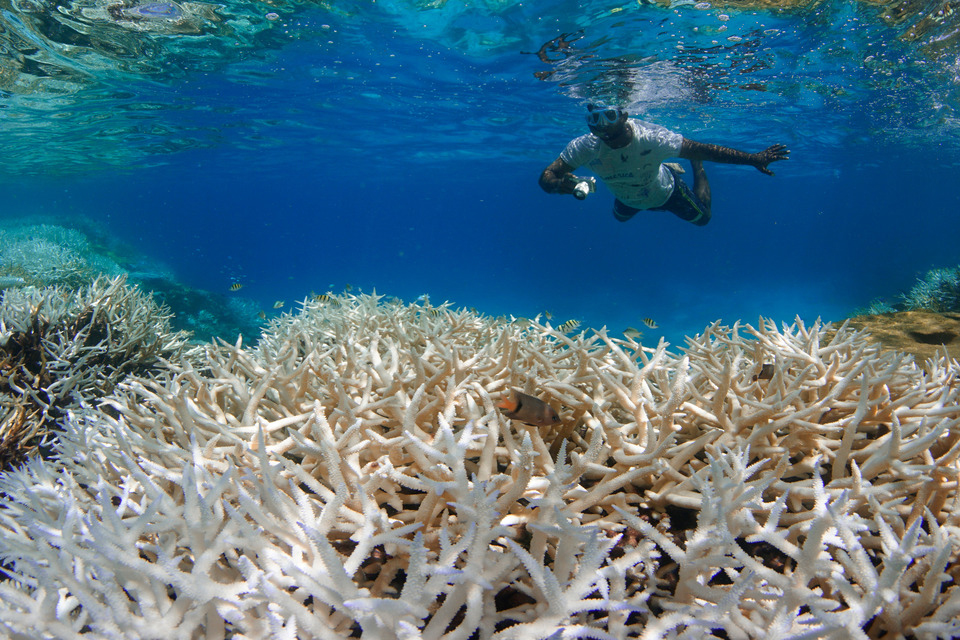
Ocean warming and coral bleaching

Human-driven stressors, especially ocean warming, threaten the long-term survival of coral reefs. An alarming 77% of the world’s reef areas are already affected by bleaching-level heat stress.

The Great Barrier Reef is a stark example of the catastrophic impacts of coral bleaching. The Great Barrier Reef is made up of 3,000 reefs and is home to thousands of species of marine life. In 2025, the Great Barrier Reef experienced its sixth mass bleaching since 2016. It should also be noted that coral bleaching events are a new thing because of ocean warming, with the first documented in 1998.

Get Ocean Updates in Your Inbox

Sign up with your email and never miss an update.

This field is hidden when viewing the form
Name(Required)
By providing your email address, you consent to receive emails from Ocean Conservancy.
Terms & Conditions and Privacy Policy


This field is hidden when viewing the form
Email Opt-in: Selected(Required)

How you can help

The planet is changing rapidly, and the stakes have never been higher. The ocean has absorbed roughly 90% of the excess heat caused by anthropogenic greenhouse gas emissions, and the consequences, including coral die-offs, are already visible. With just 2℃ of planetary warming, global coral reef losses are estimated to be up to 99% — and without significant change, the world is on track for 2.8°C of warming by century’s end.

To stop coral bleaching, we need to address the climate crisis head on. A recent study from Scripps Institution of Oceanography was the first of its kind to include damage to ocean ecosystems into the economic cost of climate change – resulting in nearly a doubling in the social cost of carbon. This is the first time the ocean was considered in terms of economic harm caused by greenhouse gas emissions, despite the widespread degradation to ocean ecosystems like coral reefs and the millions of people impacted globally.

This is why Ocean Conservancy advocates for phasing out harmful offshore oil and gas and transitioning to clean ocean energy.  In this endeavor, Ocean Conservancy also leads international efforts to eliminate emissions from the global shipping industry—responsible for roughly 1 billion tons of carbon dioxide every year.

But we cannot do this work without your help. We need leaders at every level to recognize that the ocean must be part of the solution to the climate crisis. Reach out to your elected officials and demand ocean-climate action now.

The post What is Coral Bleaching and Why is it Bad News for Coral Reefs? appeared first on Ocean Conservancy.


from Ocean Conservancy https://ift.tt/SsnZqbW https://ift.tt/aD5G4Mb

Thursday, 22 January 2026

What is a Snipe Eel?

From the chilly corners of the polar seas to the warm waters of the tropics, our ocean is bursting with spectacular creatures. This abundance of biodiversity can be seen throughout every depth of the sea: Wildlife at every ocean zone have developed adaptations to thrive in their unique environments, and in the deep sea, these adaptations are truly fascinating.

Enter: the snipe eel.

What Does a Snipe Eel Look Like?

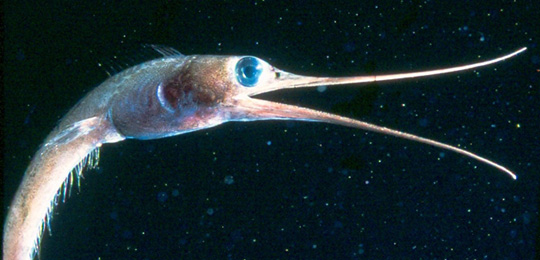
These deep-sea eels have a unique appearance. Snipe eels have long, slim bodies like other eels, but boast the distinction of having 700 vertebrae—the most of any animal on Earth. While this is quite a stunning feature, their heads set them apart in even more dramatic fashion. Their elongated, beak-like snouts earned them their namesake, strongly resembling that of a snipe (a type of wading shorebird). For similar reasons, these eels are also sometimes called deep-sea ducks or thread fish.

Close up of a snipe eel profile in turbid water

How Many Species of Snipe Eel are There?

There are nine documented species of snipe eels currently known to science, with the slender snipe eel (Nemichthys scolopaceus) being the most studied. They are most commonly found 1,000 to 2,000 feet beneath the surface in tropical to temperate areas around the world, but sightings of the species have been documented at depths exceeding 14,000 feet (that’s more than two miles underwater)!

How Do Snipe Eels Hunt and Eat?

A snipe eel’s anatomy enables them to be highly efficient predators. While their exact feeding mechanisms aren’t fully understood, it’s thought that they wiggle through the water while slinging their beak-like heads back and forth with their mouths wide open, catching prey from within the water column (usually small invertebrates like shrimp) on their hook-shaped teeth.

How Can Snipe Eels Thrive So Well in Dark Depths of the Sea?

Snipe eels’ jaws aren’t the only adaptation that allows them to thrive in the deep, either. They also have notably large eyes designed to help them see nearby prey or escape potential predators as efficiently as possible. Their bodies are also pigmented a dark grey to brown color, a coloring that helps them stay stealthy and blend into dark, dim waters. Juveniles are even harder to spot than adults; like other eel species, young snipe eels begin their lives as see-through and flat, keeping them more easily hidden from predators as they mature.

Get Ocean Updates in Your Inbox

Sign up with your email and never miss an update.

This field is hidden when viewing the form
Name(Required)
By providing your email address, you consent to receive emails from Ocean Conservancy.
Terms & Conditions and Privacy Policy


This field is hidden when viewing the form
Email Opt-in: Selected(Required)

How Much Do Scientists Really Know About Snipe Eels?

Residence in the deep sea makes for a fascinating appearance, but it also makes studying animals like snipe eels challenging. Scientists are still learning much about the biology of these eels, including specifics about their breeding behaviors.  While we know snipe eels are broadcast spawners (females release eggs into the water columns at the same time as males release sperm) and they are thought to only spawn once, researchers are still working to understand if they spawn in groups or pairs. Beyond reproduction, there’s much that science has yet to learn about these eels.

Are Snipe Eels Endangered?

While the slender snipe eel is currently classified as “Least Concern” on the International Union for the Conservation of Nature’s Red List of Threatened Species, what isn’t currently known is whether worldwide populations are growing or decreasing. And in order to know how to best protect these peculiar yet equally precious creatures, it’s essential we continue to study them while simultaneously working to protect the deep-sea ecosystems they depend on.

How Can We Help Protect Deep-Sea Species Like Snipe Eels?

One thing we can do to protect the deep sea and the wildlife that thrive within it is to advocate against deep-sea mining and the dangers that accompany it. This type of mining extracts mineral deposits from the ocean floor and has the potential to result in disastrous environmental consequences. Take action with Ocean Conservancy today and urge your congressional representative to act to stop deep-sea mining—animals like snipe eels and all the amazing creatures of the deep are counting on us to act before it’s too late.

The post What is a Snipe Eel? appeared first on Ocean Conservancy.


from Ocean Conservancy https://ift.tt/zK1oX8d https://ift.tt/d9PJqj1

How NOAA Supports Abundant Fisheries

What do a school of cod in the Gulf of Maine, a humpback whale migrating down the West Coast and a coastal wetland along the Gulf Coast have...