Join us on Wednesday, November 13 at 9:00 am EST/2:00 pm GMT for a webinar featuring Dr. Mark Bravington of Australia’s Commonwealth Scientific and Industrial Research Organization (CSIRO), where he will discuss his work to improve the information used to assess and manage shortfin mako sharks in the Atlantic Ocean.
For the past several months, Dr. Bravington has been examining the feasibility of a genetic method known as close-kin mark-recapture for estimating shortfin mako shark abundance in a way that avoids the limitations and biases associated with estimates collected through fishing activities. Such a tool could help fisheries scientists develop more accurate stock assessments to inform effective management strategies for this species, which is overfished in the North Atlantic.
from OpenChannels News https://ift.tt/2JexYy7 https://ift.tt/2WeVJM5
A conference held by the Department of Media Studies at the Institute of Modern German Literature and Media at Kiel University in cooperation with the CINEMARE International Ocean Film Festival KielApart from acting as a seemingly inexhaustible source of inspiration in poetry, music and art, the sea is one of the oldest subjects in the history of feature films and documentaries. Not only does it serve as a projection screen and playing field for cultural fantasies, technological advancements and scientific findings, but it also holds a lot of symbolic, narrative, dramatic, aesthetic, sociocultural and political potential for audiovisual media.
from "Future Ocean" – News https://ift.tt/2N3VuPr https://ift.tt/eA8V8J
This week, I am thrilled to be traveling to Oslo, Norway, where several of my Ocean Conservancy colleagues and I will convene with hundreds of other ocean experts and advocates for the sixth edition of the Our Ocean Conference. Started in 2014 by then-United States Secretary of State John Kerry, the annual conference solicits measurable commitments from governments, corporations and NGOs to tackle some of the greatest challenges facing our ocean.
In past years, for instance, Our Ocean is where we and our partners at Circulate Capital announced a $100 million fund dedicated to help stem the tide of ocean plastic pollution, by investing in collection systems in parts of the world that need it most. Our Ocean is also where we announced that New Zealand had joined the International Alliance to Combat Ocean Acidification.
As amazing as it has been in years past, I’m especially excited about this year in Norway. This is the furthest north the conference has been held, and while that may seem like an unusual distinction to make, it means that the Arctic can truly be front and center.
As you might already know, the Arctic is a unique ocean ecosystem, home to incredible animals like polar bears and beluga whales, just to name two of my favorites. Unfortunately, the Arctic is warming at twice the rate of the rest of the planet; and as the ice melts, that opens the area for increased industrial activity, from oil and gas, to fishing, to shipping. While this may benefit certain commercial sectors, it poses unique challenges for conservation—and unique opportunities, as we are able to build the rules from the ground up to protect this important habitat.
We are excited to see what others commit to in the next few days to protect the Arctic—and we have some news of our own that our CEO, Janis Searles Jones, plans to share on stage.
Beyond the Artic, this is also the first Our Ocean Conference since Ocean Conservancy became the lead partner of the Global Ghost Gear Initiative, or GGGI, earlier this year. The GGGI brings together governments, members of the seafood industry, conservationists, and others to address the threat of abandoned, lost or derelict fishing gear—also known as ghost gear. The GGGI team is already in Oslo getting ready for a number of exciting announcements that they will make from a special side event on the second day of the conference.
And speaking of side events, we are also excited to partner with National Geographic and Circulate Capital for an official side event on how to finance solutions to ocean plastic pollution. There, our own Chever Voltmer, director of our plastics initiative, will unveil our latest report, Plastics Policy Playbook: Strategies for a Plastic-Free Ocean. Based on desk-side research, in-country workshops and robust financial modeling, it’s an in-depth guide to some of the most impactful public- and private-sector interventions available to tackle the scourge of plastic pollution in parts of the world most affected by the crisis.
As you can see, we have a busy few days ahead of us! Be sure to follow us on Twitter (@OurOcean) and keep an eye on the #OurOcean and #TeamOcean hashtags for the latest.
Hade (bye, in Norwegian) for now—more from us soon!
Sign up for our emails!
...loading
Thanks for signing up for Ocean Conservancy emails.
Our ocean gives us so much. Whether you live near a coast or have never seen the ocean, you are touched by it every day—from the air we breathe, the water we drink or the food we eat. And that’s not to mention the majesty, inspiration and wonder our ocean provides at every turn. Jacques Cousteau said it well, “The sea, once it casts its spell, holds one in its net of wonder forever.”
And with all that, it is hard not to want to give something back to our ocean—but how can we do it? Swim with us through a few ways to give below, fishy friend!
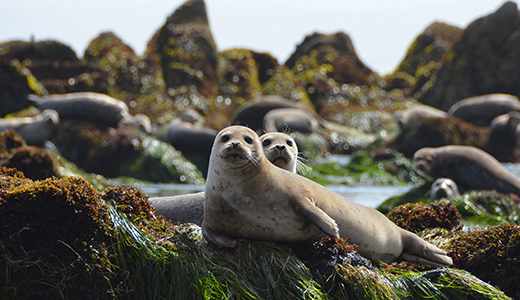
One of the best ways to give to our ocean is to help fund the researchers, scientists and advocates who are working tirelessly to protect it. At Ocean Conservancy, our scientists spend their days researching the effects of ocean plastics, ocean acidification, changing climate and more. They use this research to inform policies and advocate for the best legislation or regulations to keep our sea otter or sunfish friends—and all ocean life—safe and healthy. When you give to Ocean Conservancy, you’re making sure a walrus can care for her cubs safely on sea ice in the Arctic, a baby sea turtle can find its way back into the waves after hatching or a seal can snack on tasty crustaceans without accidentally ingesting harmful plastic—all in a healthy ocean.
Your voice is important to the fight for a healthy ocean and YOU can help by taking action. Ocean wildlife that is directly impacted by our policies and regulations do not have the ability to speak up and voice their concern—they need you to do that for them. Speak up today! Give a voice to animals in the ocean who need help. When you tell Congress that protecting endangered species is important to you or that you are against increased drilling for oil in the ocean, you are giving back to our ocean and making a major difference.
Stay up to date on ocean news!
Sign up for our emails
...loading
Thanks for signing up for Ocean Conservancy emails.
Want to give back to our ocean one wave further? Spread the word about issues facing our ocean to your friends, family and peers. Ocean Conservancy posts educational content on Twitter, Facebook and Instagram that’s just a quick share away. Want to go TWO waves further? Host a Facebook Fundraiser for a special event in your life like a birthday or big race. When you tell people the mission of a healthy ocean is important to you, they may just make it their mission too!
You can give to our ocean by helping to solve the problem of trash: participate in a cleanup! Every year, Ocean Conservancy hosts the International Coastal Cleanup where volunteers like you can comb lakes, rivers and beaches around the world for trash. And it doesn’t have to stop there: you can participate in a cleanup with Team Ocean at any time by downloading our Clean Swell app and recording debris you collect. Every piece of trash you pick up is one less piece in our ocean.
You can give to our ocean when you shop! Select “Ocean Conservancy” as your charity of choice in Amazon Smile, or check out our Shop to Give page to see the awesome retailers and creators we partner with.
There are even more ways to give back to our ocean and support solutions to our ocean’s greatest challenges. Whether you’re a whale enthusiast, an otter aficionado or just love a good ocean wave, we hope you’ll give one of these ways to give back a try!
In the dark stretches of the deep sea, food can be hard to come by. So when hundreds of thousands of pounds of food falls from above all at once, it’s a party.
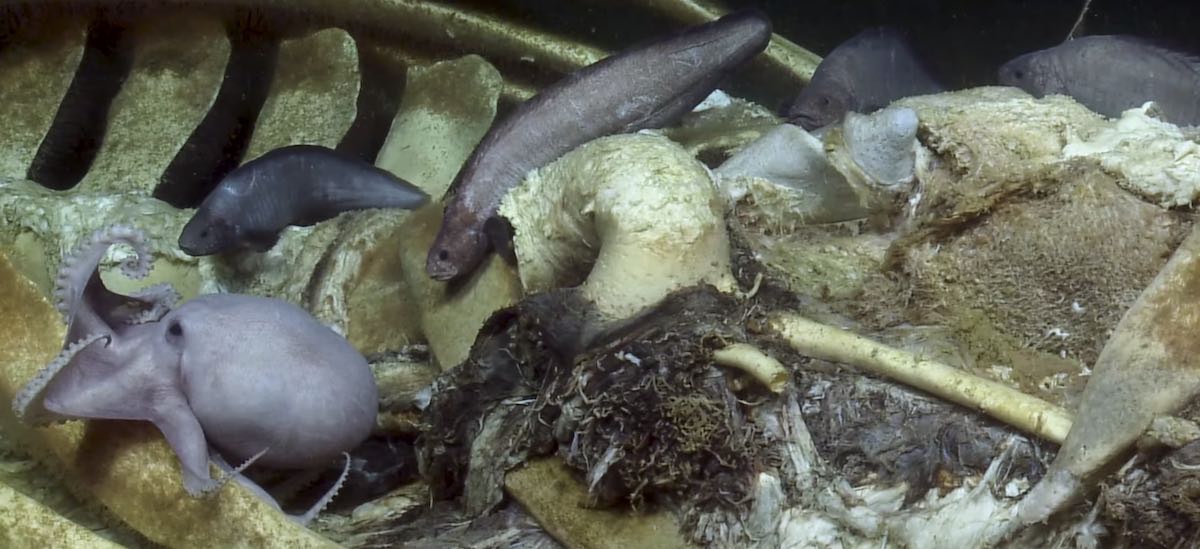
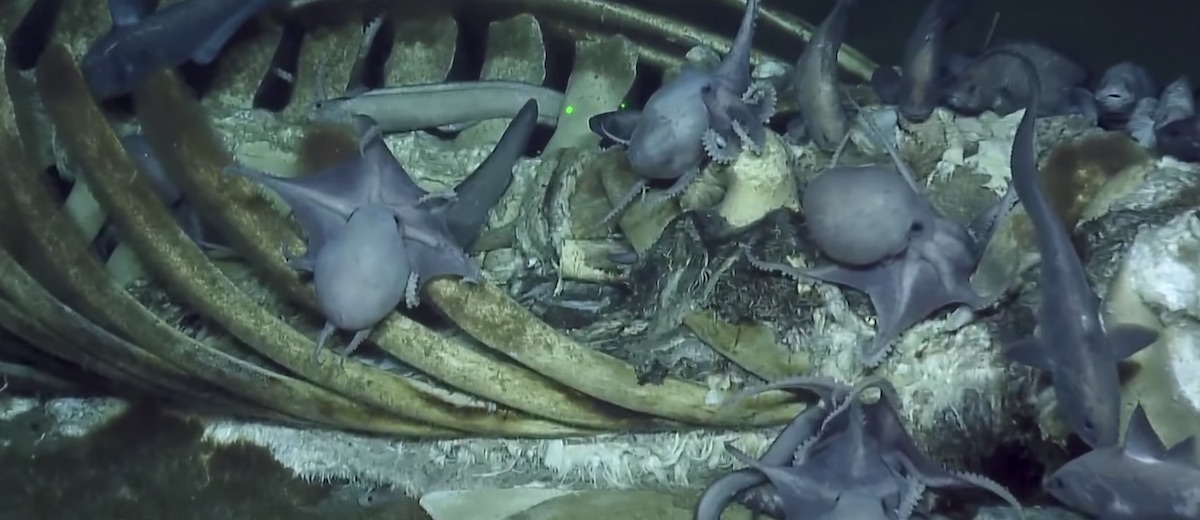
We got to see the feeding bonanza first-hand this week when research vessel E/V Nautilus livestreamed the discovery of a deep-sea whale fall. The carcass was discovered two miles below the surface while exploring Davidson Seamount in Monterey Bay National Marine Sanctuary. Viewers were treated to a close-up view of all kinds of marine creatures eating the decomposing whale (trust us, it’s less gross than it sounds).
In light of the Nautilus’ discovery, we are here to answer all of your deep-sea whale carcass questions. Read on to see why whale falls are a critical part of a healthy ocean ecosystem!
What is a whale fall? Why is it important?
When a whale dies at sea, it sinks (or “falls”) down to the ocean floor. If the animal is in shallow waters with lots of large scavengers, the body is picked apart pretty quickly by sharks, fish, crustaceans and more. But when the dead whale is in deep waters, colder temperatures greatly slow down decomposition rates, allowing the carcass to remain on the ocean floor for months or even years.
Deep sea ecosystems are food limited, meaning many organisms who live there have evolved ways to go without food for long periods of time. Many animals rely on tiny bits of organic matter drifting down from the surface, or “marine snow,” to survive. Marine snow is composed of dead plants and animals, fecal matter, dust and snow, and accumulates on the ocean floor where deep-sea critters scavenge the tiny flakes.
When a whale falls to the ocean floor, it’s like a food oasis in a deep-sea desert, and can support other marine organisms for years. One whale fall can bring the same about of organic material as 1,000 years of marine snow.
The (after)life of a whale consists of three stages: the mobile scavenger stage, enrichment-opportunist stage and the sulfophilic stage. In the mobile scavenger stage, fish like hagfish and sleeper sharks bite the meaty bits off of the carcass. This type of sloppy feeding means lots of small whale pieces end up in the surrounding sediment, attracting even more scavengers. In the enrichment-opportunist stage, crustaceans and worms take advantage of any of the small fragments of tissue left behind. The first and second stages can each last up to two years.
In the final stage, sulfur-producing bacteria break down the bones and any remaining tissue. While the bacteria break down the bones, they support a community of mussels, worms and clams that can live alongside the bacteria. This stage can last for decades, until there is nothing left of the whale.
If you watched the live-steam, you saw a number of organisms chowing down on the whale fall (if you haven’t watched it yet, what are you waiting for?). Scientists identified ghostly octopuses, eelpouts (an eel-like fish that lives in the deep sea) and grenadiers (fish with a rat-like tails that led to their nickname, rattails). They also saw Osedax worms, or polychaete worms who drill into bones and digest the lipids (their name literally means “bone-eating”). If you look at the photos, the worms look like red peach-fuzz covering the bones.
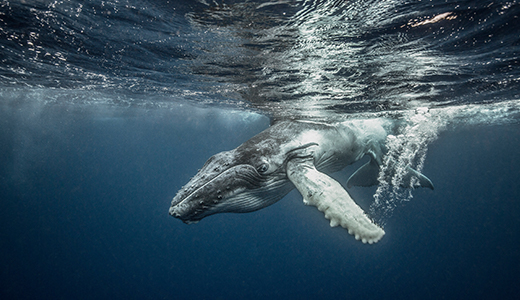
We know whales are part of a healthy, thriving ocean. And thanks to the incredible footage from the Nautilus, we have a better understanding of the important role in the ecosystem whales play after their death. Almost 70,000 whales die every year, mostly from disease or injury, resulting in hundreds of thousands of whale falls around the world at a given time. Think of the millions of marine organisms that are supported by those falls—what would happen to them if whale numbers decreased? It’s up to us to keep the ocean a safe place for whales and the organisms who depend on them.
 Join us on Wednesday, November 13 at 9:00 am EST/2:00 pm GMT for a webinar featuring Dr. Mark Bravington of Australia’s Commonwealth Scientific and Industrial Research Organization (CSIRO), where he will discuss his work to improve the information used to assess and manage shortfin mako sharks in the Atlantic Ocean.