Thursday, 3 August 2023

Do Jellyfish Have Brains?

Do jellyfish have brains? The short answer is no, jellyfish do not have brains. But this certainly does not mean they are simple creatures. In fact, not having a centralized nervous system is just one of sea jellies’ many incredible tools for defense against the brutal elements of the deep blue sea. Without a brain, a sea jelly is able to survive traumatic injuries to its bell and still function. While jellyfish may not have brains, a heart, lungs, bones or blood, their structure is incredibly unique—probably why so many of us are fascinated by them!

Instead of a brain, a sea jelly has a set of nerves commonly referred to as a nerve net or nerve ring. This nerve net helps them detect shifts in their environment, including temperature, gravity, water salinity, oxygen concentration, vibrations and currents. These nerves are responsible for the jellyfish’s automatic responses. 

Jellyfish also have clusters of nerve endings (almost like neurons) called rhopalia along their bells. Rhopalia allow jellyfish to sense light and maintain balance, ultimately helping jellies determine which way is right-side up. 

In addition, a sea jelly’s basic anatomy consists of six parts:

  1. The epidermis is the top layer of the jellyfish bell which absorbs oxygen, allowing it to disperse throughout the body. This allows jellyfish to survive without lungs, a heart or blood. 
  2. The mesoglea is the actual “jelly” part of the jellyfish, a thick gelatinous material made of mostly water with collagen and proteins. It’s also responsible for storing oxygen for extended periods of time. 
  3. The gastrovascular cavity is the inner part of the jellyfish that functions as the entire digestion system. There is one orifice that (to put it politely) serves both ingestion and elimination needs for the jellyfish. This multipurpose area is the access point to the gastrovascular cavity.
  4. The gastrodermis is the layer on the underside of the jellyfish bell and aids in extracellular digestion and gas exchange. 
  5. The tentacles of a jellyfish come in all shapes and sizes, depending on the type of jellyfish. Tentacles are what hold a sea jelly’s nematocysts, the tiny cells responsible for their stings. A lion’s mane jellyfish holds the record for the longest tentacle, with some measuring in at more than 100 feet long—that’s about as long as a blue whale!
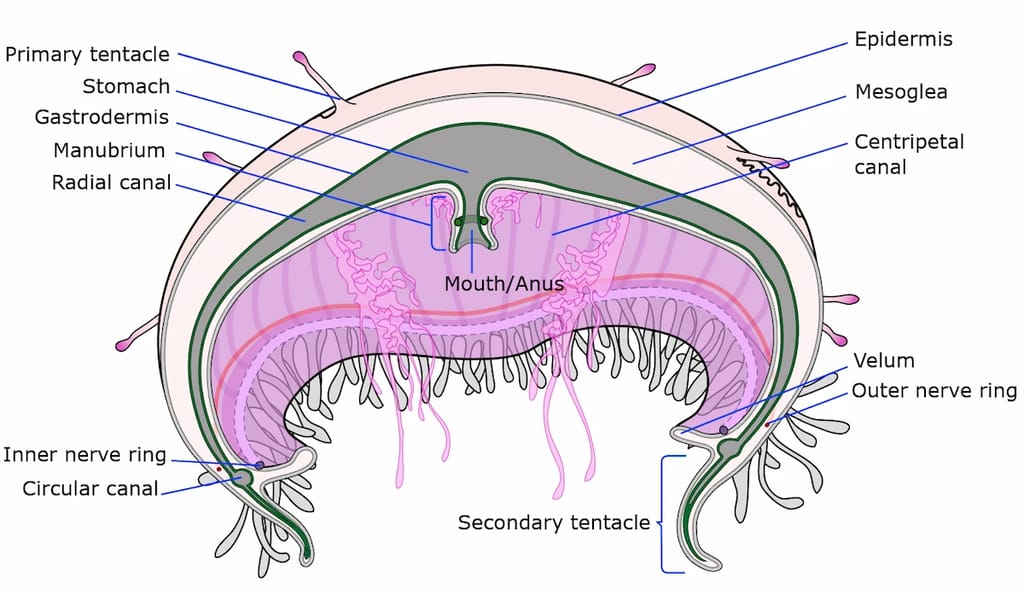
Jellyfish diagram
Cross-section diagram of the hydrozoan species Olindias formosa’s jellyfish-like medusa form.

Some species, such as the box jellyfish and moon jellies, even have “eyes” or eye-like structures. While moon jelly “eyes” are simple light-detecting structures called ocelli, box jelly “eyes” include a cornea, pupil, lens and retina. Numbers of eyes vary by creature¾while the moon jelly has only two “eyes,” box jellies have up to 24 “eyes.”

Did you know jellyfish are among the oldest species of animals in the world? Fossils have been found that indicate jellyfish have been around for more than 500 million years. Even without bones, brains, lungs or a heart, sea jellies have certainly made their mark in our beautiful ocean and our hearts. 

With an estimated 2,000 species out there, jellyfish are just one of the spectacular creatures inhabiting our beautiful ocean. It’s up to all of us to help protect them so they inspire wonder and feed sea turtles and other ocean animals for another 500 million years. Please make a donation to Ocean Conservancy to celebrate these creatures—give today and make a difference for the future of our ocean!

The post Do Jellyfish Have Brains? appeared first on Ocean Conservancy.


from Ocean Conservancy https://ift.tt/9czyUMh https://ift.tt/lo128Dg

Thursday, 20 July 2023

How NOAA helps Communities Weather Hurricane Season

I moved to South Carolina only two months before Hurricane Matthew made headlines in October 2016 as the first Category 5 Atlantic hurricane in almost a decade. I still remember the quiet, sunny days as Hurricane Matthew made its way towards my new residence. The nearby interstate highway reversed to bring evacuees inland from the coast. Along with my fellow classmates, I waited as Matthew caused widespread destruction across the Caribbean before turning towards the southeastern United States and making landfall only a few hours from my adopted home. 

I remember feeling relief after the wind quieted and I checked in with friends and neighbors. While everyone I knew was safe, I found Matthew had left scars on the land. The record flooding from Hurricane Matthew disrupted life, not just on the coast, but in communities far inland.  Ultimately, Hurricane Matthew caused more than $16.5 billion in damage and claimed more than 600 lives. The horrible impacts of Matthew’s rainfall would soon be repeated by others, like Harvey (2017) and Florence (2018). This is not a coincidence or simply bad luck. Rainfall rates from hurricanes are increasing due to climate change

This year’s Atlantic hurricane season, which began June 1, 2023, has already experienced its third tropical system, Cindy. Although the Atlantic hurricane season was originally forecast to be “near-normal” by NOAA, record warm waters have caused a research team from Colorado State University to change their forecast to “above-average.” In the Pacific, also warm, partially due to this year’s El NiƱo, Typhoon Mawar struck Guam in late May. Both of these storms occurred less than nine months after the devastation of Hurricane Ian. Ian and Mawar reached the equivalent of Category 5 as storms, though thankfully not at landfall. 

All of this information begs a few questions about this year. What do we know about climate change and hurricanes? How are the folks at the National Oceanic and Atmospheric Administration (NOAA) helping with all this extreme weather? 

How is climate change impacting hurricane seasons?

  • Coastal floodingSea levels are rising as the ocean heats up and polar ice melts. Higher seas mean higher storm surge and more coastal flooding leading to coastal community and ecosystem damage. 
  • Water pollution: As rainfall rates increase, overburdened and crumbling stormwater infrastructure is spewing sewage into waterways, not just on the coast but upstream. For example, the street-level drains in Tampa Bay lead to the Bay, where Ocean Conservancy scientists are finding a host of ripple effects on ecosystems after storms
  • Infrastructure damage: The strongest storm winds are projected to increase and a higher percentage of tropical cycles will reach very intense levels (Category 4 and 5) which can result in coastal infrastructure loss, as well as damage to toxic structures, such as petrochemical plants, producing unpermitted air and water emissions.
  • Less preparation time: A warming ocean is leading to more rapid intensification of hurricanes and shrinking the time for preparation and evacuation.
  • Cumulative impacts: Heat waves, mosquito-borne diseases and other hazards combine with existing social vulnerabilities and hurricane impacts to cause “compound” disasters.  

How is NOAA helping communities—and you—better prepare for hurricanes?

  • Continuously improving forecasting: Neither you nor state and local governments can respond without having the information needed to assist in decision-making. NOAA’s National Weather Service is adding new Hurricane Hunter aircraft and super computers to improve the accuracy and timeliness of forecasts, including and especially as climate change alters what we know about these storms.
  • Strengthening coastal resilience: Nature-based solutions, such as protecting wetlands, planting mangroves and installing oyster reefs, act like natural airbags, dampening storm surge and diffusing wave energy. The Coastal Zone Management (CZM) Program, a voluntary partnership between NOAA and coastal and Great Lakes states, coordinates and provides grant opportunities for state efforts that increase community and coastal resilience. NOAA has also announced grants towards coastal resiliency projects totaling $562 million, with another $575 million opportunity open now, all thanks to the Bipartisan Infrastructure Law and Inflation Reduction Act. 
  • Preventing pollution: Old water infrastructure is not capable of handling the rainfall or sea level rise caused by climate change. By updating these systems, coastal communities and ecosystems are protected from harmful pollution. NOAA, including through CZM grants, works with states to address current and future potential pollution sources. When the pollution is trash—or even destroyed boats and fishing gear—NOAA’s Marine Debris program can help with cleanup. For example, NOAA’s Marine Debris program helps fund local efforts such as Ocean Conservancy’s Plastic Free Cities.  
  • Supporting Justice40: Historically marginalized communities are particularly vulnerable to hurricanes and other climate impacts due to a lack of investment in disaster preparedness and recovery. The Biden administration and NOAA have been actively putting 40% of federal investments towards these communities to address disparities and improve climate resilience where it’s needed most. Learn about parallel efforts by Ocean Conservancy to uplift the Justice40 mission.  
  • Stopping greenhouse gas emissions: Our best chance to limit climate change impacts, like more intense hurricanes, is to rapidly deploy renewable energy and move away from fossil fuels. NOAA collaborates with the Bureau of Ocean Energy Management (BOEM) to help implement offshore wind here in the United States in a responsible and just manner. Watch this recent video from Ocean Conservancy about NOAA and BOEM’s collaboration

Most importantly, while NOAA can help prepare us for the weather, it is up to each of us to make smart and safe decisions as well. Atlantic and Pacific hurricane seasons run through November. But destructive stormscan happen throughout the calendar year. It is important to ensure you have a personal plan for yourself and family, no matter where you live. 

From the Atlantic to the Pacific, NOAA creates climate-ready coasts, provides vital data to communities like mine, and helps clean up the destruction after a storm. It is one agency that we could not do without in today’s modern hurricane era.

The post How NOAA helps Communities Weather Hurricane Season appeared first on Ocean Conservancy.


from Ocean Conservancy https://ift.tt/fSHqUpI https://ift.tt/P8l2cJQ

Friday, 14 July 2023

Five Books that Explore LGBTQIA+ Experience with the Ocean

For me, Pride month is always a time to celebrate our big, beautiful community, honor all those who came before, and continue the fight for our rights. It is also an opportunity for me to reflect on the ways queerness weaves its way through my work, the environmental movement and the natural world. However, June doesn’t have to be the only time we focus on the history, advocacy and vibrancy of the LGBTQIA+ community. Even though Pride Month has ended, I wanted to offer up some awesome and relevant LGBTQIA+ books to add to your summer beach reading list.

These queer authors weave the ocean into their own narratives and offer us an opportunity to continue to explore the intersections in the environmental and LGTBQIA+ rights movement. 

Undrowned

“May you study the pink of yourself. Know yourself riverine and coast. May you taste the fresh and the saltwater of yourself and know what only you can know. May you live in the mouth of the river, meeting place of the tides, may all blessings flow through you.” – Undrowned by Alexis Pauline Gumbs

I have read Undrowned by Alexis Pauline Gumbs at least five times since I first bought it. Each lesson is a beautiful meditation on our connection with marine mammals. Gumbs eloquently relates the struggles faced by many marginalized communities with the struggles of survival marine mammals face in the ocean. She finds inspiration in the queer and protective behavior of these ocean animals and teases out important life lessons from her wonder for the natural world. 

How Far the Light Reaches

“I want to know what kinds of transformation the cuttlefish is capable of when it is motivated not by fear but by community and sex, and I am not interested in calling it a disguise.” ― How Far the Light Reaches: A Life in Ten Sea Creatures by Sabrina Imbler

Sabrina Imbler and I share a love of the ocean’s wacky, weird and strange creatures. As a journalist writing on science and conservation, their work invokes wonder in the mysteries of the ocean. How Far the Light Reaches is an exploration of the ocean’s most fascinating creatures and of Imbler’s own life. They poetically weave stories around the formation of their own queer identity with stories of yeti crabs scuttling around in the most inhospitable of ocean habitats or sand strikers waiting in the deep for their prey. This book serves up powerful reflections on sexuality, survival, relationships and community care from the dark waters under the ocean waves. 

Love After the End

What does it mean to be Two-Spirit during an apocalypse? What does it mean to search out romance at a pipeline protest—can we have intimacy during doomsday?” – Introduction by Joshua Whitehead to Love After the End

Love After the End is an incredible anthology that contains nine science-fiction stories from two-spirit and queer Indigenous writers. Each story is a vision of the future with a mix of utopian and dystopian tales. These writers bring visions of the rise of resistance movements, journeys to other planets and tales of lost loves brought to life by virtual reality. Each look into the future is full of the love and joy experienced in two-spirit and queer Indigenous communities. 

Queer Nature

“Hard to be a creature of earth in a world covered with water.” – “A Little Bit of Ocean” by Joy Ladin from Queer Nature

I picked up Queer Nature in the process of writing this piece, and it has been my favorite companion ever since. This anthology is full of poems by LGBTQIA+ voices that connect their experience with the natural world. There are incredible ocean gems like “Hermit Crab” and “once a marine biologist told me octopuses have three hearts” that are evocative and emotional. There are more than 200 poems in Queer Nature, and each one presents a unique look into the bonds between queerness and our environment.  

Voice of a Fish

“Noting these aquatic bodies helped me dissolve a world I found too hard, too strict in how it required me to live within it.” –  Voice of the Fish by Lars Horn

Lars Horn has been called “the mystic’s David Attenborough.” Their book, Voice of the Fishdraws parallels between the ocean’s ever-changing ways and their own gender fluidity. It is a collection of tales from Horn’s own life that flows together in a wave mixed with tales of the ocean and marine history. Their story draws ebbs and flows like an ocean current outside of expectations, boundaries and binaries.  In each of these excellent reads, the ocean is a powerful symbol and teacher. I hope you pick up one of these books and further explore the ocean and our shared human experience. 

The post Five Books that Explore LGBTQIA+ Experience with the Ocean appeared first on Ocean Conservancy.


from Ocean Conservancy https://ift.tt/4vAMV9F https://ift.tt/mdLe6Vv

Tuesday, 27 June 2023

The Unique Unicornfish

Sometimes, you can look at an animal and their name just makes sense. Tiger sharks have tiger-like stripes, sea slugs look like land slugs and blue whales are, well, quite blue. The same thing is true for the aptly named unicornfish.

As you can probably guess, the unicornfish gets its moniker from the unicorn-horn-like protrusion sticking out of its face. But what is that distinctive feature for? And what else is there to know about the unicornfish? Read on to have all your burning unicornfish questions satisfied.

What is a unicornfish?

Unicornfishes comprise a group of fish in the genus Naso, which is under the family Acanthuridae. You might know other fish in the family, including tangs and surgeonfishes (including the blue tang made famous by Dory in Finding Nemo). There are about 19 species within the genus Naso, but only some of them have the iconic “horn” protruding from their faces.

Where can you find unicornfish?

You can find unicornfishes in the tropical and subtropical regions in the Indo-Pacific seas (sorry Atlantic Coast residents, no unicornfish for you!) They typically find shelter in coral reef structures and can also be seen swimming over the top of the reef to feed. They are classified as diurnal planktivores, meaning they eat small plankton during the daylight hours. When they’re not feeding, they like to hide in nooks and crannies on the reef. Although it may look like they’re not up to much when they hide, unicornfish play an important role in the reef: Their waste helps provide nutrients to the corals. 

What’s the deal with the horn?

Only nine of the 19 species within Naso have the horn-like protuberances that give them their name. There are two types of “horns”—one that is actually shaped like a long horn and one that is more rounded.

Scientists aren’t entirely sure why unicornfishes have their horns, but there are some theories. One thought is that males use their horns as a way to signal to females that they are good mates. They also can change the color of their horns to “compete” against other males and stand out to females. Although both males and females have the protuberance, it appears that mostly males are the ones that change their horn color.

What’s the status of unicornfish?

Good news! According to the IUCN Red List, many species of unicornfish are considered of “least concern,” meaning we aren’t currently worried about them going extinct. But that doesn’t mean they’re out of the woods (or out of the seaweed, that is!): Like many species, unicornfishes rely on healthy, sustainable reef ecosystems. Coral reefs are currently under threat from climate change, and there is no healthy future for our reefs—and the animals who depend on them—unless we act now to reduce greenhouse gas pollution. Take action with Ocean Conservancy to urge policymakers to combat climate change before it’s too late.

The post The Unique Unicornfish appeared first on Ocean Conservancy.


from Ocean Conservancy https://ift.tt/83U0iJ5 https://ift.tt/Y6LB3si

Friday, 23 June 2023

Is There a Difference Between Arms and Tentacles?

At Ocean Conservancy we love cephalopods AND we love being very specific about … well, everything. So, what better blog to dive into than one on specific terms and information about cephalopod appendages. This blog contains all the information you didn’t know you needed.

Arms, tentacles—the words are often used interchangeably because they are both types of appendages found on cephalopods. But, in reality, they are different, and each has their own unique characteristics and functions.

Similarities

As all cephalopods are invertebrates, cephalopod tentacles and arms both lack bones for structure. They are made from muscle fibers (much like your tongue). And, both tentacles and arms on cephalopods can regrow or regenerate. These arms and tentacles have strong suckers that work just like suction cups. While arms have suction cups the entire length of the limb, suction cups on tentacles are found only near the end of the limb.

What is a tentacle?

Tentacles are elongated structures, and they are generally longer than the length of the arms. Animals use their tentacles to catch or snatch prey from farther away through their ability to extend and retract. And typically, tentacles come in pairs.

Tentacles have suction cups only near the end of the limb. The suction cups on some squid species are shaped like sharp hooks to better grasp their prey. This makes them very efficient as underwater predators. The suction cup rings of squids are made of “suckerin” proteins that are similar in strength and structure to the protein found in spider’s silk.

What is an arm?

Arms have suction cups the entire length of the limb and can perform finer, more complex actions compared to tentacles. With eight sucker-lined arms and, in some cases, a pair of tentacles, a cephalopod has a really tight grip. But how a cephalopod maintains that grip differs between squid and octopus.

Squid mainly use their suckers mainly for grabbing food, whereas octopuses have figured out how to use their suckers for a wide variety of activities—including walking and handling objects.

Do the arms have their own brain?

Each of the octopus’s arms has a small cluster of nerve cells that controls movement, so technically octopuses have eight independent mini-brains along with a larger central brain.


Have you heard this joke before? Let’s laugh at it together…

How many tickles does it take to make an octopus laugh?

Ten tickles

And, the octopus laughs because… THEY DON’T HAVE ANY TENTACLES! They have arms.

Tentacles, Arms, Suckers

  • Octopuses have eight arms and no tentacles.
  • Cuttlefishes have eight arms and two tentacles.
  • Squids have eight arms and two tentacles.
  • Nautiluses have no arms and around 90 suckerless tentacles.
  • Coral have tentacles and no arms.
  • Jellyfish have tentacles and no arms.
  • Sea anemones have tentacles and no arms.

How can we help octopuses, squid and jellyfish?

There is still so much we can learn about the creatures living in the ocean—which is one of the many reasons that we should continue working together to protect their habitat.

Who knows what we will discover about them next?

We won’t find out if we don’t protect the ocean and the animals that dwell within it.

Join Ocean Conservancy today!

The post Is There a Difference Between Arms and Tentacles? appeared first on Ocean Conservancy.


from Ocean Conservancy https://ift.tt/rm4G508 https://ift.tt/4je1YCn

Thursday, 22 June 2023

2023 Photo Contest Winners Announced

Ocean Conservancy’s Annual Photo Contest has ended, and it’s safe to say that this was our best yet. Hundreds of you sent breathtaking ocean photos, and we are so impressed. Thank you for sharing your images with us—we are so grateful.

We are thrilled to announce our 2023 Photo Contest winners!

Judge’s Choice Winner:
Synchrony in Motion by Rachel Moore


A once-in-a-lifetime encounter with humpback whales in the crystal-clear waters of French Polynesia. While drifting miles offshore looking for whales this trio, mother, calf and male escort came in for a close pass in perfect synchrony.” — Rachel Moore

Born and raised by the sea, the ocean was Rachel’s first love. At just seven years old, she knew she wanted to become a diver and explore the world hidden below the surface. For the past seven years, Rachel has slowly been sailing around the world on her boat Agape, capturing the wild beauty of our planet to inspire others to protect and conserve our precious ocean. Follow along Rachel’s adventures on Instagram at @moore_rachel.

What Our Judges Had to Say

  • “What can be better than sharing the ocean with humpback whales? Likely very little. These three stacked humpbacks create an engaging moment of living art complete with sunbeams illuminating them like spotlights from above. I’m certain this was nothing short of a magical moment in time.” – Alex Rose
  • “Harmony, respect, fragility and the power of nature, generations embodied in an image, with how vast the ocean is but at the same time the great challenge of safeguarding it due to the impact that human beings have made.” – Karen Fuentes
  • “…the lighting and composition are incredible.” – David Coffey

Category Winners

The winners of our photo contest categories—Human Impact, Marine Wildlife and Spectacular Seascapes—were selected by ocean lovers like you who came out in droves to vote for their favorite photos. Thank you to everyone who voted and shared the contest with others.

Human Impact Winner:
Choked Up by Nicholas DeNezzo

“Bystanders crowd and look on at an entangled California sea lion. As a rescue professional, this scene is a part of our everyday life, in which we deal with the fishing gear, trash pollution and other human impacts affecting our local marine life.” — Nicholas DeNezzo

Follow Nicholas DeNezzo on his website, www.nicholasdenezzo.com, and Instagram, @nickipedia_.

Marine Wildlife Winner:
Climate Endurance by Jenny Wong

“Taken August 2, 2021 in Admiralty Inlet, just a short boat ride from the small hamlet of Arctic Bay. We were standing on top of a cliff with a 500mm lens, a polar bear mother and her two cubs swim by. Well adapted for the ocean, adult polar bears though taxing on energy is very well equipped to navigate the waterstheir young cubs not so much. As the open water season gets longer in the Arctic, mothers will struggle to not only feed herself but also her young, and long commutes to safety or better hunting grounds becomes an arduous journey for their future.” — Jenny Wong

Follow Jenny Wong on her website, www.JennWong.ca, and Instagram @jdubcaptures.

Spectacular Seascapes:
The Shallows by Maximilian Holba

“Simple bliss: On a calm early morning, when the reef awakens from its nightly slumber, and small fish are again swirling around and about, making you feel like you are in a tropical aquarium, you can be in the moment and soak in the wonderful cornucopia of marine life, to forget for just one brief moment, all the unfortunate truths of the climate’s peril and the ocean’s pollution…” — Maximilian Holba

Follow Maximilian Holba on his website, https://maxholba.com/, and on Instagram @maxbeyondthesea.

Thank you to our judges and to all who participated, voted, shared and submitted photos—you truly made this year’s contest a success. Congratulations to ALL our entrants, and we hope to see you next year for our 2024 contest.

The post 2023 Photo Contest Winners Announced appeared first on Ocean Conservancy.


from Ocean Conservancy https://ift.tt/Z4wYjKL https://ift.tt/yeTZiDU

Thursday, 15 June 2023

Meet the Needlefish

If anyone in my family has a question about the ocean, I’m the first person they ask. While I was on vacation recently, my sister would constantly point at things swimming beneath the waves and ask me, “What’s that?” One of these creatures was a needlefish, and at the time I knew almost nothing about them. Who were these little swimming sword fighters who seem ready to joust on any occasion? It was eerie watching these long slender fish swim among humans enjoying the water. Would they challenge anyone to a duel? I had questions, and, honestly, my search for the answers led me down some dark paths. 

Am I now afraid of needlefish? Possibly. Do I think they are the villainous rogues of the ocean’s surface? Absolutely. You may look at that little fish and think nothing of it but I’m here to tell you: Think again. 

Where do you find needlefish? 

Just like that face that haunts your dreams, once you know what needlefish are, you’ll see them everywhere. They hang out in shallow waters or near the surface of the ocean. Most live in saltwater, though there are a few species that live in freshwater or brackish (mix of saltwater and freshwater) environments. Needlefish like warm water so you’ll often find them in tropical areas around the world. Wherever you might head on a relaxing vacation, a needlefish might be there lurking, just offshore. 

What’s that big pointy sword-looking thing for?

It’s clear how a needlefish got its name. In the front of its face is a long, narrow mouth that looks a bit like a needle. While that swordlike front is scary enough, it opens into a mouth with tons of small pointy teeth. These teeth are not for chewing but for making sure their prey does not escape. Which means a needlefish swallows their prey whole. 

What do needlefish eat?

Needlefish usually eat smaller fish, but how they digest them is a weirder story. That’s because needlefish don’t have stomachs. At some point in their evolution, they ditched that organ in favor of an acid-free approach to breaking down their meals. That means nothing turns a needlefish’s stomach because they’ve got no stomach to turn. 

Scarier still, needlefish are smart hunters that seem to take advantage of an underwater phenomenon called Snell’s window. If you have looked up when you were swimming underwater you might have noticed a cone of light that allows you to see up to the surface. That’s Snell’s window, which is caused by the way light refracts through water. While things inside the window are clear, everything around it is dark or distorted. A needlefish will use this disorientation to its advantage, allowing it to get very close to its prey without their being any the wiser. Waiting in the shadows for the right time to attack with your sword? A needlefish sounds like a rogue if I ever saw one.

How fast is a needlefish? 

A needlefish will make short jumps out of the water while hunting its prey. Needlefish can move up to 40 mph when they make their leaps. Needlefish move so fast that they can tail walk, where they appear to walk on the water straight up on their back ends. They’ll even skip along the surface like you might skip a stone, gliding along the waves. 

In their haste, they will often jump over low lying boats instead of swimming under. This can be dangerous for humans on those boats who can be struck by their sharp beaks at high speed. Swimmers, boaters, kayakers and windsurfers have been struck and seriously injured by needlefish. It is important to note, though, that these incidents are rare and accidental. Needlefish aren’t aggressive towards humans and usually avoid contact all together. While I won’t be signing up for a needlefish fan club anytime soon, these rapscallions are an important part of our ocean ecosystem. The truth is, they may have more reason to be afraid of us then we have to be afraid of them. In Pakistan, a needlefish was found dead trapped in a discarded plastic cup that had ended up in the ocean. Living closer to the shores means they also live in habitats polluted by our trash. No creature deserves to live in a dump. Take action with Ocean Conservancy to prevent plastic pollution now.

The post Meet the Needlefish appeared first on Ocean Conservancy.


from Ocean Conservancy https://ift.tt/W9MEyeY https://ift.tt/jBzaFvk

The Annual Migration to Clean Up Our Coasts

Annually, seasonally and sometimes even daily, amazing oceanic migrations are taking place. Humpback whales migrate thousands of miles to b...