Thursday, 27 October 2022

Don’t Mess With Damselfish

If you’ve snorkeled on a reef in the tropics, odds are you’ve seen damselfish. These small but colorful fish are staples in many aquatic habitats, but how much do you really know about damselfish? Dive in as we explore five fast facts about damselfish.

There are many different types of damselfish. 

There are about 250 species of damselfish in the family Pomacentridae, a group which also includes clownfish. They come in a range of colors and patterns, from the aptly named four striped damselfish to the vibrant blue damselfish. Across all species, there are a few things they have in common: Their bodies are deeper than they are wide, and they have forked tails. Plus, they don’t get too big—the largest damselfish, the Garibaldi, grows only to about a foot long. 

Damselfish are found in a wide range of habitats. 

Most damselfish are found in marine, or saltwater, habitats in the Atlantic and Indo-Pacific oceans. There are a few others found in brackish or freshwater habitats, like the (again, aptly named) freshwater damselfish. Damselfish are commonly found in warm, tropical regions, but they can also be seen in subtropical zones. Also, many species are popular as aquarium fish, so you might see one in a friend’s home aquarium. 

They pack a punch.

Damselfish are small, but they’re surprisingly mighty! Some damselfish species are extremely territorial, meaning they will fiercely defend their homes from threats, including other damselfish. They will quickly and aggressively swim towards intruders to scare them away from their territory. 

Sometimes they’re unwanted. 

A few species of damselfish are considered invasive, meaning they’re in areas where they don’t naturally live and are causing harm to the local environment. One invasive species is the regal damselfish which originated in the Indo-Pacific Ocean and is now found in the Gulf of Mexico and western Atlantic oceans. Scientists aren’t exactly sure how they got to their new ranges, but it could have happened with people dumping their aquariums or from regal damselfish hitching a ride on international oil rigs. 

They’re tiny gardeners. 

Some species of damselfish are “algae farmers,” meaning they actually nibble away at the habitat to cultivate algae growth. They bite unwanted algae to remove it, allowing other, more desirable algae species to grow. This is part of a balanced coral reef ecosystem, but there can also be too much of a good thing: Some damselfish can eat live coral tissue in their quest to create an algae garden. Too many damselfish can stress out an already stressed reef. 

Can’t get enough fun fish facts? Check out our Wildlife Fact Sheets and visit our Action Center to help protect all animals that live in the ocean.  

The post Don’t Mess With Damselfish appeared first on Ocean Conservancy.


from Ocean Conservancy https://ift.tt/3pf7bPF https://ift.tt/zSuHBVI

Monday, 17 October 2022

Are Fisheries Ready for Climate Change?

The ocean has buffered our planet from the impacts of climate change, absorbing much of the carbon dioxide we’ve emitted and a substantial amount of the heat from our warming atmosphere. That comes at a cost. The ocean is getting higher and hotter; it holds less oxygen; and it’s becoming more acidic. In short, the ocean is becoming less familiar and its patterns less recognizable.

Marine species have been swimming in these changing waters for years now, and we are starting to understand what that means for them. Fish populations are shifting their ranges in response to changing temperatures and food availability, and scientists predict that the potential global catch could decrease by as much as 16-25% by the end of the century.[1] Habitats, like kelp forests and coral reefs, are diminishing. Marine mammals and seabirds are struggling to find sufficient prey during extreme events like marine heatwaves.[2]

The effects of climate change on marine ecosystems come at a cost to people, businesses and cultures. Coastal communities which engage in fishing are deeply dependent on a familiar ocean to sustain their way of life. We can already see the impacts of change, as many fish populations that have been sustainably managed for years have had frightening declines. In Alaska, Tribes and Alaskan Natives who have fished sustainably for millennia can now no longer fish their traditional salmon runs as too few fish return to streams and rivers. Multiple crab species are vanishing in the North Pacific, shutting down major commercial fisheries. In New England, there are questions about whether the water is now too warm to allow fish populations to recover from historic overfishing. Warm “blobs” of water, which are large and long-lasting marine heatwaves, haunt the West Coast of the United States and have resulted in decreased fishing opportunities and harmful algal blooms. Hurricanes fueled by climate change and “super storms” have devastated fishing communities far and wide, from northwest Alaska to the Gulf of Mexico.

We know these changes are happening, and we know they will get worse. Large-scale climate models that predict how our planet will respond to emissions show steady increases in global temperatures and impacts until at least 2050, which is the earliest that emissions-reductions efforts that we take right now will change the course of our planet’s warming.[3] That’s because there’s so much “thermal inertia” in the climate system—heat absorbed long ago is continuing to warm our planet today. While the U.S. has taken bold climate action recently with the passage of the Inflation Reduction Act, our climate future is already set for the next 30 years. The climate will get warmer before it stabilizes.

That’s why the recent findings of a report about U.S. fishery management by the Government Accountability Office are so shocking. The report found that only a quarter of the 46 management plans that determine sustainable levels of fishing for over 450 critically important marine fish stocks in the U.S. consider climate change at all. It concluded that NOAA Fisheries, the government agency responsible for ensuring that our ocean fisheries are managed for the long-term good of the public, should identify and prioritize opportunities for managers to enhance the climate resilience of federal fisheries.

Fundamentally, we need to apply new approaches to change the way we manage fisheries in the U.S. We’ve built a strong foundation, as decades of evidence-based management approaches have helped reduce overfishing, rebuild stocks and restore coastal communities. But if we don’t find ways to adapt, climate change will rob us of a sustainable fishing future. NOAA Fisheries has worked for years to build a scientific understanding of how[AM1]  climate change is altering our fisheries, investing in efforts to understand marine ecosystems, monitor indicators of change and build advanced predictive models to look into the future. More must be done there, but the Government Accounting Office report shows that the science and information already available is not making it into management decisions. It does us no good to understand what will happen if we fail to take steps to respond to it.

We are running out of time, but the good news is that we have many of the pieces we need to make a difference. Now, we need bold leadership from NOAA Fisheries to reimagine our approaches for managing fishing. Climate-ready fishery management will prioritize sustainability, resilience and equity in order to preserve the ocean’s long-term ability to provide food and support businesses, recreation and culture. We know the ocean will keep changing. If we fail to adapt, sustainable fisheries and the benefits they bring will be only a thing of the past.


[1] Cheung, W. W. L., Bruggeman, J., and Butenschön, M. (2018). “Projected changes in global and national potential marine fisheries catch under climate change scenarios in the twenty-first century,” in Impacts of Climate Change on Fisheries and Aquaculture: Synthesis of Current Knowledge, Adaptation and Mitigation Options, eds M. Barange, T. Bahri, M. C. M. Beveridge, K. Cochrane, S. Funge-Smith, and F. Poulain, (Rome: Food and Agriculture Organization of the United Nations), 63-85.

[2] Cooley, S., D. Schoeman, L. Bopp, P. Boyd, S. Donner, D.Y. Ghebrehiwet, S.-I. Ito, W. Kiessling, P. Martinetto, E. Ojea, M.-F. Racault, B. Rost, and M. Skern-Mauritzen, 2022: Oceans and Coastal Ecosystems and Their Services. In: Climate Change 2022: Impacts, Adaptation and Vulnerability. Contribution of Working Group II to the Sixth Assessment Report of the Intergovernmental Panel on Climate Change [H.-O. Pörtner, D.C. Roberts, M. Tignor, E.S. Poloczanska, K. Mintenbeck, A. Alegría, M. Craig, S. Langsdorf, S. Löschke, V. Möller, A. Okem, B. Rama (eds.)]. Cambridge University Press, Cambridge, UK and New York, NY, USA, pp. 379–550, doi:10.1017/9781009325844.005.

[3] IPCC, 2021: Summary for Policymakers. In: Climate Change 2021: The Physical Science Basis. Contribution of Working Group I to the Sixth Assessment Report of the Intergovernmental Panel on Climate Change [Masson-Delmotte, V., P. Zhai, A. Pirani, S.L. Connors, C. Péan, S. Berger, N. Caud, Y. Chen, L. Goldfarb, M.I. Gomis, M. Huang, K. Leitzell, E. Lonnoy, J.B.R. Matthews, T.K. Maycock, T. Waterfield, O. Yelekçi, R. Yu, and B. Zhou (eds.)]. Cambridge University Press, Cambridge, United Kingdom and New York, NY, USA, pp. 3−32, doi:10.1017/9781009157896.001.

The post Are Fisheries Ready for Climate Change? appeared first on Ocean Conservancy.


from Ocean Conservancy https://ift.tt/1EdcMB7 https://ift.tt/lz7QTBS

Monday, 3 October 2022

How Are Fishery Managers Using Climate Data?

This blog was written by Michele Conrad, advisor to Ocean Conservancy on achieving priority fish conservation and ecosystem goals on the West Coast. As a former state ocean policy manager, Michele represented the State of Washington on the Pacific Fishery Management Council for 15 years before starting her own consultancy. She is passionate about helping fisheries manage their way through climate change and furthering ocean conservation efforts.

Ever see something unusual or out of context and it takes a moment to register what exactly you’re seeing? 

When our eyes see an image, our brain interprets it by searching an internal database of visual references—a process that usually happens within a fraction of a second. However, new research shows that when it’s harder to recognize an object, our perception of that object is shaped by what we know and our personal experience. This insight into how knowledge and experience affect perception could not be truer when it comes to fishery management, including how we estimate the status of fish populations.

For decades, scientists have estimated how many fish are in the ocean and fishery managers have used those estimates to determine how many fish can be sustainably caught. NOAA Fisheries’ surveys gather biological and environmental data, including the climate, ecosystem and fish data that can be used to form “images” for fishery management—they are our eyes in the ocean. These surveys form a strong scientific foundation for fishery management decisions.

Scientists use the data to create and interpret the “images,” which are like puzzles, and as they try to find the pieces that fit, the images often remain blurry. Stakeholders—fishermen, processors, anglers and conservationists—and fishery managers all have different perceptions of those images based on their individual knowledge and personal experiences.

Even in the best conditions, estimating the number of fish in the ocean is like counting birds in the forest … except we can’t readily see or hear the fish. Not only is that “forest” more than 60 million square miles in size, if we’re talking about the Pacific Ocean, but ocean ecosystems are also complicated and dynamic, and environmental factors are intertwined and influence each other. To add to the complexity, climate change is causing oceanographic changes to occur more rapidly, more frequently and to greater extremes. 

In short, climate information can be an important part of the larger picture of how fish populations are doing.

But are fishery managers using that information?

In at least one region, the answer is “yes.” The Pacific Fishery Management Council’s (PFMC) Ecosystem and Climate Information Initiative (aka Initiative 2.1 described here), which they adopted in September 2022, is a collaboration among scientists, fishery managers and stakeholders to essentially create and interpret the “image” of how fish are doing along the West Coast. It is a proactive step to preparing Pacific fisheries for climate disruptions.

Through the initiative, scientists will study how different climate and ecosystem factors could impact specific fish stocks. By identifying those relationships and understanding how climate change has already affected fisheries in other regions, managers will be better prepared for shifting environmental conditions. Doing this will tell us there can be more fishing when conditions are favorable and provide early warning systems to tell us when things are looking bad so we can pull back. Using climate information also means we better understand fishing’s relationship with vulnerable habitats and ocean food webs, as well as changing pressures that fishing communities are facing.  In other words, by taking these steps, the Pacific Council will improve their perception of the status of fish stocks in the ocean, which will lead to better, climate-informed fishery management decisions that can help avert a fishery disaster.

Some have worried that including climate information will make the tricky task of estimating fish in the ocean even more challenging (i.e., that it will make a blurry image even worse). And trying to enhance the image by expanding research surveys is difficult and expensive. But as the new study on the human visual pathway concluded, the key to improving our understanding (our perception) is to expand what we know and learn from our experiences.

So, instead of ignoring climate information or just focusing on collecting more data, the PFMC will be using the environmental data NOAA already gathers in combination with the information from our collective experiences (i.e., the fisheries we know have been affected by climate change) to improve our understanding of fish populations. This information can also help us manage the populations sustainably even as ocean conditions shift due to climate change. It’s definitely a step in the right direction towards more resilient fisheries.

The post How Are Fishery Managers Using Climate Data? appeared first on Ocean Conservancy.


from Ocean Conservancy https://ift.tt/osQxuGi https://ift.tt/UpxnI9X

Tuesday, 13 September 2022

Three Ways You Can #SeaTheChange 

The plastic pollution problem is vast. Plastics have been found everywhere from the Mariana Trench, the Earth’s deepest trough, to the top of Mount Everest, our planet’s highest peak. Yet this massive problem is one we can start addressing today. And what is great, absolutely everyone can be a part of the solution. 

I am inspired to work to keep our ocean cleaner every day because I’m not alone as I face a tidal wave of trash heading to our ocean. I’m joined by hundreds of thousands of people who join us each year for the International Coastal Cleanup®. Every year volunteers, like you, come out to your beaches, waterways, parks and neighborhoods to pick up trash. This year you can be the change that helps the ocean #SeatheChange. All you need to do is to join our league of ocean heroes and come out and clean up! 

The International Coastal Cleanup kicks off this Saturday, September 17, 2022. but you can start working toward a healthier ocean now! Join us for an entire season of action by working to protect our ocean with these helpful tips: 

Learn and Take Action

When I work with scientists and community leaders from around the world on this issue of ocean trash, I always discover there is more to learn. Sometimes I find a new dimension to the problem, but I also often find new solutions. As you start on your journey, we have great resources both to dive deeper into the issue and to take action to promote high-impact solutions. I’ve chosen a few great topics to get you started, but you can always plunge into the latest on Ocean Conservancy’s work toward Trash Free Seas® on our blog. 

Tiny Plastics Are a Big Problem

plastic on the beach

The term “microplastics” describes tiny pieces of plastic that are often too tiny to see. While these plastic particles are small, the ocean feels their impact in a big way. Our dependence on plastics in our daily lives has led to widespread contamination of microplastics in some of the most remote places in the world. This is because microplastics are produced when bigger plastic items—such as shampoo bottles, foam cups, plastic bags and even old clothing—break up in the environment. Microplastics impact the health of the ocean, its sea life  and even our own bodies due to microplastic contamination in what we eat and drink. What we put in our environment matters—not only for the sake of the planet, but also for our own health. Use your voice to push for policies to help keep microplastics out of our ocean.

From Parks to the Ocean

It isn’t hard to understand why we must protect our majestic national parks that remind us of the many natural wonders our planet and our own country hold. Plastic pollution doesn’t just threaten our national treasures by sea and land, it can also pollute them from the air. Scientists recently discovered that microplastics can be transported by wind, and more than 1,000 metric tons—roughly the weight of 1,000 elephants—fall onto national park lands each year! Recently, the U.S. Department of the Interior announced an order to phase out the sale of single-use plastic products in national parks by 2030, but there is more we can do now to protect our country’s wonders. Take action to push for policies that keep plastics out of our national parks.

The Tale of Ghost Gear

When we think of plastics in the ocean, the image that comes to mind often is that of the kinds of plastics we see in everyday life. Yet the most widespread and deadliest form of debris in the ocean is one you probably haven’t seen before: ghost gear. Simply put, this is fishing gear that is lost in the ocean. A single abandoned commercial fishing net is estimated to kill an average of 500,000 marine invertebrates, 1,700 fish and four seabirds. You can learn more about ghost gear by taking our quiz. Then, put that knowledge to work by taking action to tackle this single most harmful form of plastic pollution.

Organize a Cleanup 

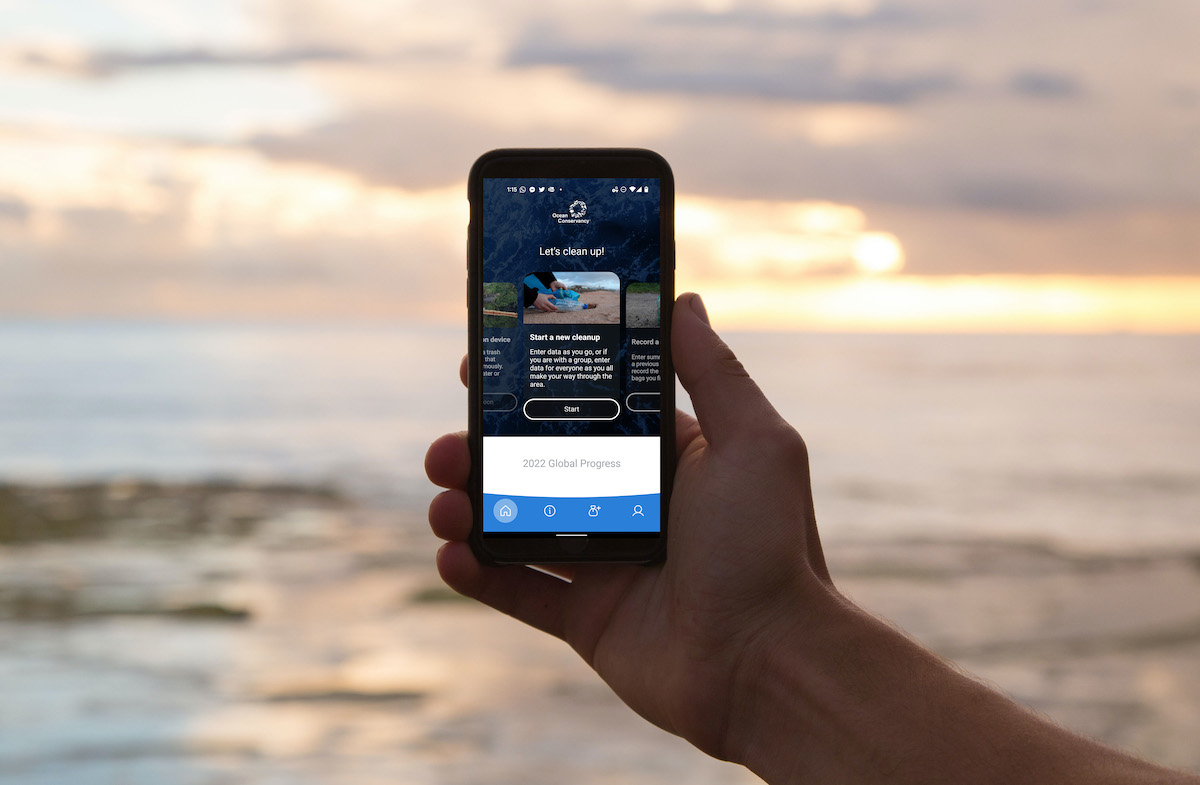
Clean Swell app on phone

We love watching people come together each fall for a healthier ocean, but that’s by no means the only time you can join us for a cleanup. You can use the Clean Swell® app anytime to log a cleanup and help power science and policies that create long lasting solutions to the plastic pollution crisis. Try out plogging to incorporate trash cleanups into your daily run or pick up a few pieces of litter while walking your dog. Get your friends and family involved to help remove trash from a local park before celebrating with your favorite pastime or a nice meal. We’ve got everything you need to bring people together for a cleanup with our step-by-step guide. 

Reduce Waste at Home

One way we can help the ocean is by reducing our reliance on plastics at home. Many of the most common items found by International Coastal Cleanup volunteers can easily be avoided or replaced. Here are some easy places you can reduce plastic waste in your life: 

The International Coastal Cleanup is a wonderful time for celebrating ocean advocates like you and inspiring everyone to work towards a cleaner, healthier ocean. You can find even more ways to get involved by texting “ICC” to 69866 or signing up for our email list in the footer below.

The post Three Ways You Can #SeaTheChange  appeared first on Ocean Conservancy.


from Ocean Conservancy https://ift.tt/6vVbCEf https://ift.tt/X8sv6V1

Wednesday, 7 September 2022

Celebrating 50 Years of Ocean Conservancy

It’s a very exciting time here at Ocean Conservancy. We’re celebrating fifty years—five decades—of advocating for our ocean. I am honored to be at the helm of this incredible organization as we reflect on this important moment in our history and look forward to our future.

Ocean Conservancy has seen so much in the last 50 years—many victories and many challenges. But one thing is for sure: Our network of dedicated ocean advocates, including people like you, has grown tremendously. It’s thanks to you that we’re able to look back on all the ocean triumphs we’ve celebrated together over the years, and look forward to what comes next.

In honor of the last 50 years of ocean conservation, here are a few of the (many) highlights and current areas of work:

As tempting as it is to spend today reminiscing about the past, we also need to look to the future. Although we have seen some big challenges over the last five decades, we are likely to see even greater challenges in the next 50 years.

Despite this, I’ve never been more hopeful for the future of our ocean. More and more people are advocating for immediate climate action to protect each other and our ocean. We’re embarking on critical work to include more diverse voices and viewpoints in conservation. And we are witnesses to a generation of young people who are rising up to fight to live in a sustainable, just and equitable world.

In honor of our 50th anniversary, I hope you’ll join me in taking action to support ocean conservation. For five easy ways to help our ocean today, just remember the acronym O.C.E.A.N:

  • Open an ocean conversation. One of the best ways to get loved ones to act for our ocean is to share stories of why you love the ocean and why it needs our help.
  • Check the candidates. Whether it’s climate crisis, plastics or ocean justice, it’s not too early to find out where the candidates stand on the ocean issues that matter to you.
  • Enjoy the ocean. Even if you don’t live near the ocean, simply enjoying a story, photo or video about the ocean reminds us of all it has to offer.
  • Act for the ocean. Join us in a cleanup or check out our Action Center for more ways you can help right away.
  • Now is the time—think about the future we want for our ocean, and what it takes to get there. By acting now, we can change the future.

I am honored to work alongside you and can’t wait to see what we achieve in the next chapter of Ocean Conservancy’s history. Thank you, as always, for your support. And thank you for joining us in celebrating this exciting and humbling milestone. Here’s to 50 more years!

The post Celebrating 50 Years of Ocean Conservancy appeared first on Ocean Conservancy.


from Ocean Conservancy https://ift.tt/O9tRjHw https://ift.tt/jfDCcWk

Thursday, 1 September 2022

Highlights from Ocean Conservancy’s Inaugural Shores Forward Summit

It’s been more than two years since Ocean Conservancy’s Florida Conservation Program launched Shores Forward, our flagship initiative to create positive change for our ocean across Florida. We work with local governments to implement on-the-ground projects with local changemakers and partners. We now bring these successes to Tallahassee where we advocate and help craft legislation that protects our ocean.

When we launched our first Shores Forward partnership with City of Miami in 2019, we were eager to help make impactful projects come to life. Since then, working with local governments, we have brought Shores Forward to Miami Beach, Orlando and soon, Pinellas County. Our vision for the future of the Shores Forward initiative is to create a community of practice in which these projects across Florida are catalysts for learning and an undeniable swell of support for our ocean.

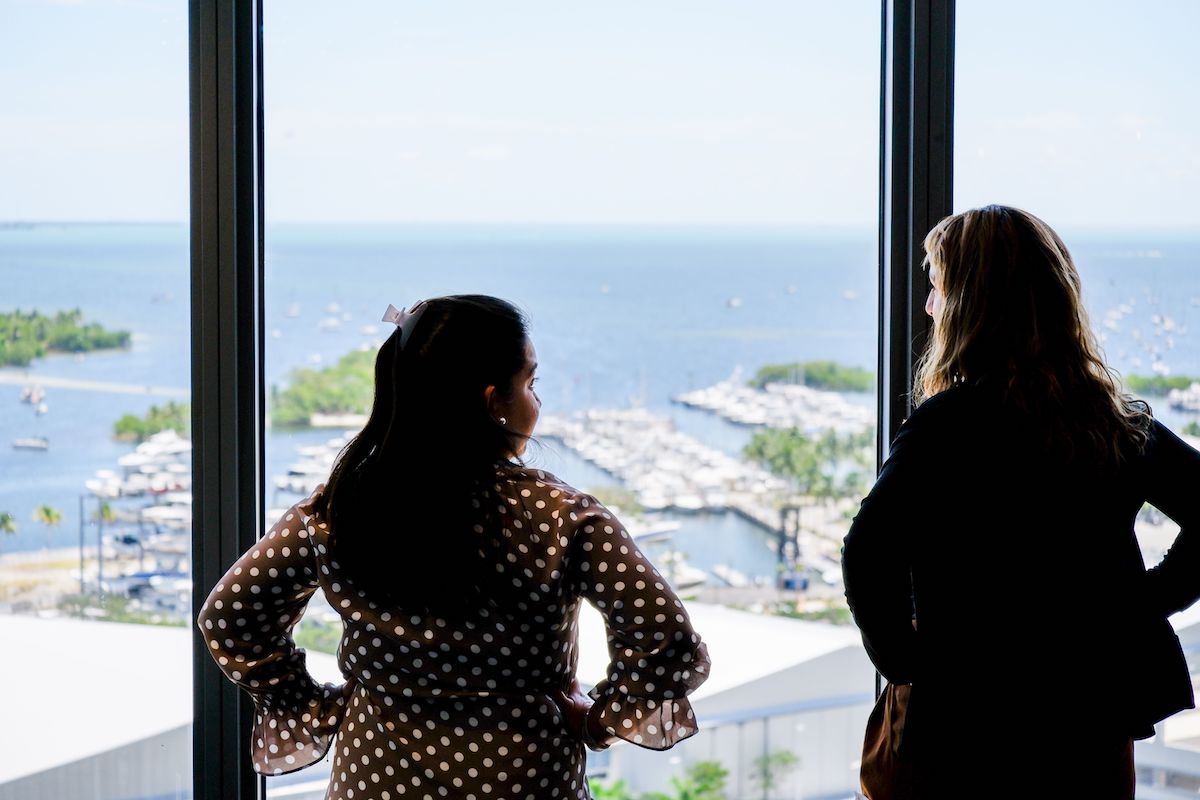
Two participants of the Shores Forward Summit look out at the Miami skyline
© Ocean Conservancy

Our goal is for Florida to become the model for innovative and effective marine conservation.

On August 26, we celebrated two years of this powerful work by convening the inaugural Shores Forward Summit. Our partners across south and central Florida joined our Ocean Conservancy team in Miami for an all-day event where we celebrated collective wins and announced exciting upcoming projects.

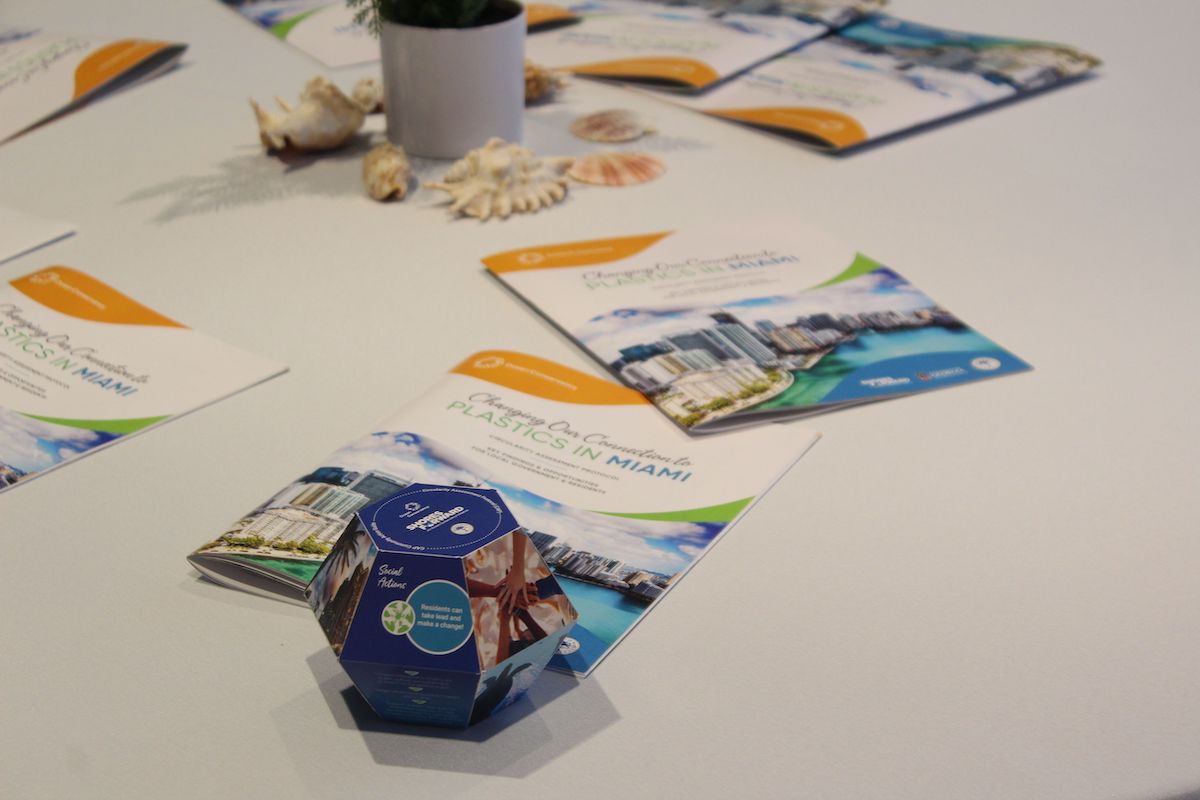
Staff from City of Miami, City of Miami Beach, Miami-Dade County and City of Orlando participated in panel discussions and brainstorms alongside more than 70 non-governmental organization partners, including Dream in Green, Debris Free Oceans, Healthy Little Havana and Big Blue & You. Ocean Conservancy announced the latest developments in the work to support the findings from the Miami Circularity Assessment Protocol (CAP) with the launch of the CAP Community Action Guide. Professor Jenna Jambeck, from the Circularity Informatics Lab at University of Georgia, shared the methodology of the CAP and key takeaways from the Miami CAP.

Shores Forward Summit
© Ocean Conservancy

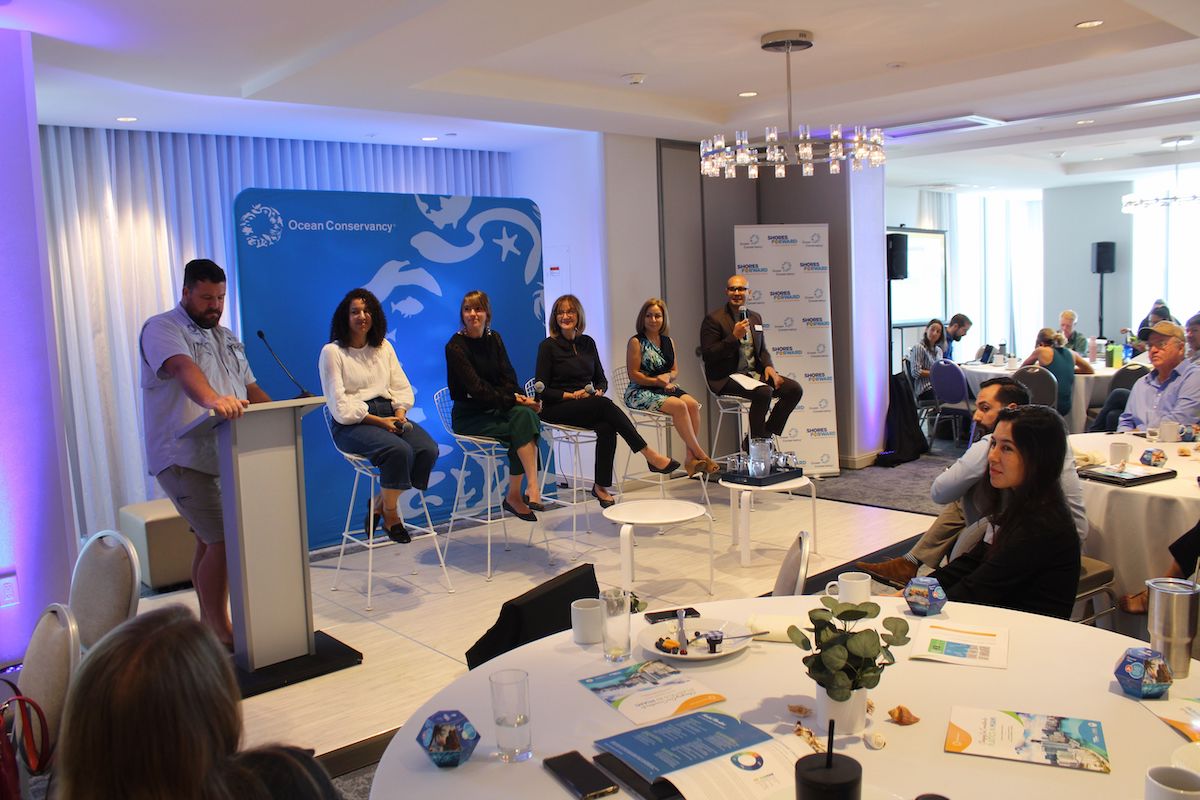
Building on the success and momentum behind tackling marine debris in South Florida, Ocean Conservancy announced a recent award from the National Oceanic and Atmospheric Administration (NOAA) to reduce marine debris in the Miami River and in Biscayne Bay. The two-year grant will fund the expansion and implementation of Plastic Free 305 in key portions of Miami-Dade County, alongside partners Debris Free Oceans and Big Blue & You. Building on the business-focused voluntary campaign to reduce single-use plastics, Ocean Conservancy and partners will work with high school students in eight schools to train the next generation of environmental and sustainability champions to canvas local businesses across Hialeah, Hialeah Gardens, Medley, Miami Springs and City of Miami to eliminate single-use plastics. A panel discussion consisting of Ocean Conservancy, Chief Bay Officer Irela Bague, District 5 Miami-Dade County Commissioner Eileen Higgins, Debris Free Oceans Co-Founder and Executive Director Caiti Waks and Miami Beach Environment and Sustainability Department’s Senior Sustainability Coordinator Alyssia Berthoumieux highlighted the need to coordinate across levels of government and the public to move away from single-use plastics.

Shores Forward Summit speakers sit on stage
© Ocean Conservancy

Attendees were also given a sneak peek into City of Miami’s Sustainable Events Action Guide. The Sustainable Events Action Guide will be given to all special-event applicants in City of Miami to guide them in organizing a sustainable event. The guide includes information on sustainable transportation and energy use, protecting sensitive habitats and avoiding waste and plastic pollution. Following the sneak peek, we held a Q&A panel on the genesis of the Sustainable Events Action Guide with Miami-Dade County Chief Heat Officer Jane Gilbert, Ocean Conservancy staff and representatives from City of Miami and Ascendance Sustainable Events.

Near the end of the day, key partners in the audience participated in a brainstorming session to capture major takeaways and identify potential areas for collaboration. Ideas spanned from prioritizing the most troublesome plastics to focusing on boater and tourist education. Everyone left with recycled-plastic coasters to commemorate the inaugural Shores Forward Summit.

Attendees agreed that the inaugural Shores Forward Summit was a wholehearted success that left them and Ocean Conservancy staff buzzing with excitement for what’s next in Shores Forward’s future.

The post Highlights from Ocean Conservancy’s Inaugural Shores Forward Summit appeared first on Ocean Conservancy.


from Ocean Conservancy https://ift.tt/6xbimO3 https://ift.tt/Dxp41j6

Cheers to Pipefish

Ask anyone on the street, and chances are they can tell you about seahorses. You don’t need to be an expert to recognize these small, odd-looking critters—their long faces are really unique in the ocean. Or are they?

Pipefishes are close relatives of seahorses and seadragons, but they don’t get nearly the amount of attention. Today, we’re going to change that! Here are a few things to know about pipefish.

Pipefish are (almost) everywhere

Pipefish are in the family Syngnathidae, which also contains seahorses and seadragons. There are more than 225 species of pipefish found all over the world, from the tropics to the subarctic (but you won’t find any at the poles, unfortunately). There are a few freshwater species, but most are marine.

One species, the Atlantic snake pipefish (Entelurus aequoreus), exhibited a curious range shift in the early 2000s. These fish used to be an unusual sight in northern Norway, but in 2002, they expanded their range pole-ward. Suddenly, people were seeing these “rare” fish in big numbers, likely due to changes from warming waters. Their numbers in northern waters dropped again by 2007, but scientists are keeping an eye out to see if their populations fluctuate again. This species is not alone in that distinction—scientists have seen plenty of range shifts in the face of climate change.

Pipefish shape is important

Pipefish might not have the flashy body shape that their seahorse cousins have, but their shape works for them. They have long, slender bodies—as if you stretched out the coiled body of seahorse into a straight line. Many species hang out in seagrass beds or coral reefs where they can blend into swaying grasses and soft corals.

Some pipefish are quite small; the dwarf pipefish, for example, only grows to about four inches. The brushtail pipefish, on the other hand, can grow to 25 inches. They use their elongated mouths to suck up tiny prey items like small crustaceans.

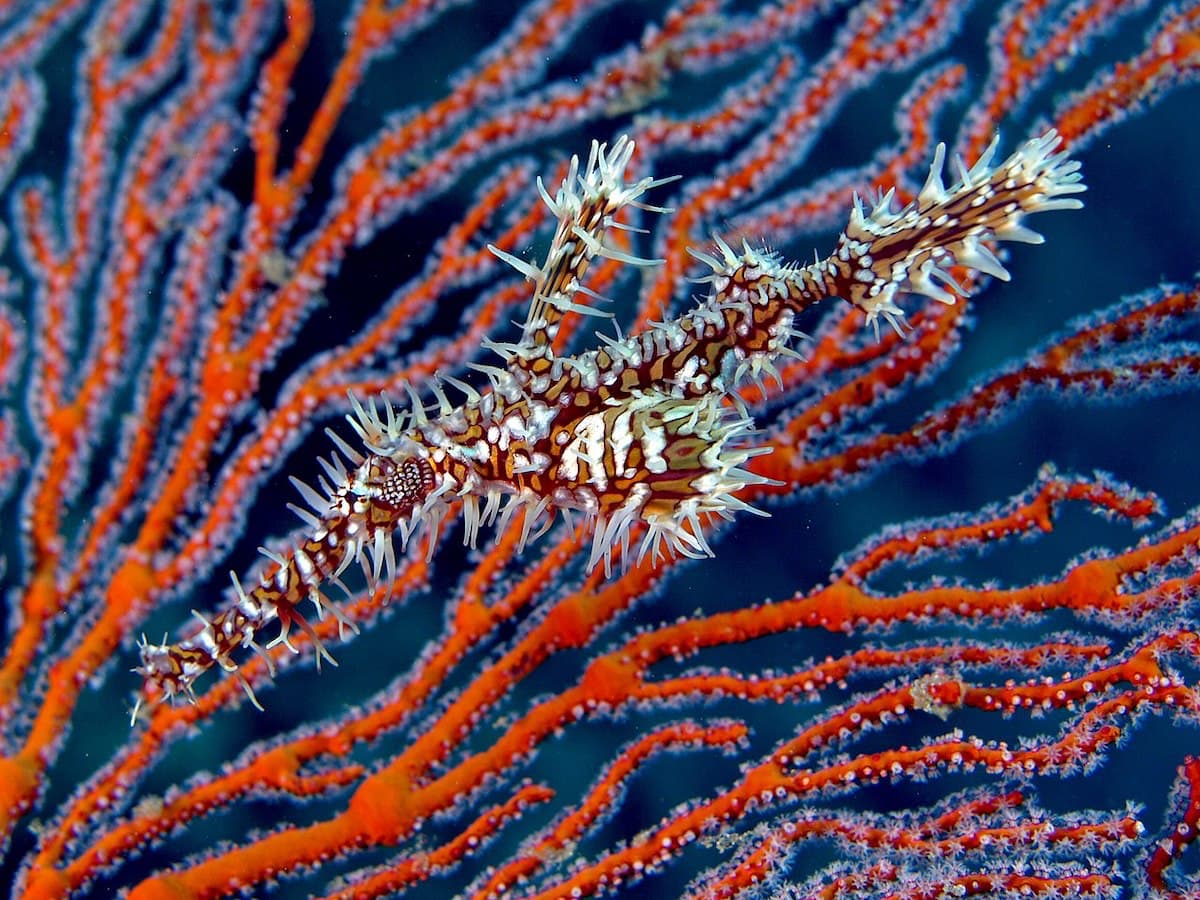
 Boo! There are ghost pipefish

brightly colored ghost pipefish in the ocean
Ghost pipefish are a relative of pipefish, but they are in different families © Nick Hobgood/ Wikimedia

Ghost pipefish look similar to pipefishes but are actually in a different family. (I know, taxonomy is confusing.) They’re in the family Solenostomidae, which has six species that are mostly found in the Indo-Pacific region.

Ghost pipefish look drastically different than their more streamlined pipefish cousins. Many have intricate camouflage that they use to blend into corals, crinoids and other structures on the sea floor. The ornate ghost pipefish, also known as the harlequin ghost pipefish, can have the bright red “stalk” and flowing white “tentacles” of a soft coral. The robust ghost pipefish has a rich brownish-green or reddish color that perfectly blends with algae or leaves.

Pipefish dads have a unique role

Like seahorses, pipefish flip the script in reproduction. Females lay their eggs in the male’s brood pouch where he fertilizes them. Then, he will keep them safe and sound until the baby pipefish are ready to hatch. Location of brood pouches vary for different species; snake pipefish, for example, have the pouch on their stomachs where broadnose pipefish have it on their tails. In many species, the males can provide nutrients and oxygen to their offspring straight through the pouch.

Pipefish face changing threats

Pipefish are a diverse group, and some species are more threatened than others. The estuarine pipefish, for example, is found in South Africa and is critically endangered. It was so rare that scientists declared it extinct in 1994 before it was rediscovered in 1996. But generally, pipefish are at risk from threats like pollution, climate change and habitat loss that affect many ocean species.

Learn about Ocean Conservancy’s efforts to combat climate change and protect unique animals like pipefish.

The post Cheers to Pipefish appeared first on Ocean Conservancy.


from Ocean Conservancy https://ift.tt/HyzcqTp https://ift.tt/Dxp41j6

How Orlando Communities are Tackling Plastic Pollution

The city of Orlando is known above all else for its world-class amusement parks. In fact, hundreds of thousands of people visit the city ev...