Monday, 23 November 2020

An Ocean of Gratitude

Thanksgiving looks a little different this year. We know that many plans have been interrupted and people are opting to do things differently to protect family and friends.  And yet, some things remain the same: this is a time for giving thanks. It’s also a time to reflect on the historic realities of the holiday. I’ve been learning more about what this holiday means for our Native American friends and colleagues. I am committed to continuing the conversation in order for us all to feel seen and heard. If you want to learn more, I encourage you to read this article, which I found very helpful in reframing Thanksgiving in context of its history.

2020 has been quite a year, to say the least. We’ve faced a global pandemic, a contentious election and unprecedented economic and social challenges. Things have been hard, and continue to be hard, for families and communities around the world.

But despite all of that—and because all of that—we have seen incredible examples of compassion, love and resilience. We’ve seen people wearing masks to protect each other, waiting in long lines to exercise their right to vote and rallying for the rights of Black, indigenous and other people of color.

We’ve also seen great wins for our ocean. I am in awe of those who have continued to advocate for our ocean throughout this trying year, including my wonderful colleagues at Ocean Conservancy and dedicated supporters like you. This is no small feat, especially in the time of an administration that has pushed for anti-ocean and anti-climate policies.

In a COVID world, we still found creative and safe ways to help our ocean. Meetings shifted from in-person chats to Zoom calls, where we talked with policymakers about protecting the Arctic from increased shipping. Our annual International Coastal Cleanup shifted from big groups to small, socially-distanced volunteers who used the Clean Swell app to track the amount of trash and plastic they collected. And dedicated supporters like YOU took action to protect critical environmental legislation like the Endangered Species Act (ESA) and the National Environmental Policy Act (NEPA) by making your voice heard to policy makers.

I am thankful that throughout this challenging year, people continued to help our ocean—and each other. The health of our planet is inexplicably tied with the health of its people, and this year has brought a renewed commitment to ensuring a just and equitable future for all. To truly solve the many issues facing our ocean, we must prioritize racial justice. I am thankful to all those committed to integrating justice, equity, diversity and inclusion in their work, and look forward to continuing this fight in 2021 and beyond.

As we look towards a new year, we are also looking towards a new administration. After a long and stressful election season, Americans came out in record numbers to elect Joe Biden as the next President of the United States. After four years of egregious policies that have hurt our ocean and disproportionately impacted people of color, Ocean Conservancy is ready to work with the new administration and Congress to help re-establish the United States as a global leader in ocean conservation and a meaningful actor on climate change—the single greatest threat facing our ocean. As an incredibly difficult year comes to an end, we are hopeful for the future and committed to our mission: creating science-based solutions for a healthy ocean and the wildlife and communities that depend on it.

The effects of this virus and this contentious political climate have spared no one, and it is understandable that people are hurt, tired and uncertain. And yet, people are working hard every day to make a better world for all of us—including a healthier ocean and more just planet. This year, I’m grateful for moments of kindness and hope for the future in these trying times. Most of all, I am grateful for the passion and dedication of ocean lovers like you.

From all of us, I wish you and your loved ones a happy, healthy and safe Thanksgiving.

The post An Ocean of Gratitude appeared first on Ocean Conservancy.


from Ocean Conservancy https://ift.tt/2J0vhDa https://ift.tt/eA8V8J

Friday, 20 November 2020

Remaining Vigiliant in the Face of COVID-19

As I look at the news this week, I realize that it’s been a long year and a longer month (and we’re only halfway through November!). We made it through a challenging election season, to now face the concerning and rapid increase in COVID-19 cases across the United States. Here in Oregon, where I am writing, Governor Brown has implemented what she is calling a “freeze”—restricting social activities and closing some businesses entirely to prevent the virus from spreading further as we head into the holiday season.

All of us at Ocean Conservancy are sending our support and well-wishes during these unprecedented—and yes, concerning—times. We are also sending a huge thank you and an ocean of gratitude to frontline workers, including those in the health care, research, service and transportation sectors. After a long year, people are understandably eager to be with family and friends for the upcoming holidays. And yet, we need to remember how we entered this pandemic and do everything we can to #FlattentheCurve.

The last two weeks have been the worst for the United States since the pandemic began. According to the COVID Tracking Project, the United States has more than 11 million cases and more than 239,000 deaths. At this point, almost everyone knows someone who has been touched by the virus. Black, brown, Indigenous and people of color are being hit hardest by the pandemic; recent research shows that Black people are twice as likely to be afflicted by the virus as white people. As we head into the holidays, it’s important to be vigilant.

Ocean Conservancy is a science-based organization, and scientists and experts are telling us to stay home, keep six feet apart when around others, wash our hands frequently, limit any indoor gatherings to small groups, preferably people in your “bubble” or household and to wear a mask when out in public. As CEO, my first priority is reducing the risk of exposure for staff—and I am encouraging everyone to follow the advice of health care professionals so we can #FlattentheCurve this winter.

While COVID-19 affects all of our lives, the challenges facing our ocean and the wildlife and communities that rely on it have not diminished. As I mentioned at the start of this pandemic, we are incredibly fortunate that we can largely continue our ocean conservation work (with the creative use of technology, social media and other tools) thanks to our dedicated staff, partners and supporters like you.

When I talk about ocean conservation to staff, friends and supporters, I often talk about the long-term, big picture—something that Ocean Conservancy is known for and is the hallmark of our durable ocean conservation work. Although at times the trials facing our ocean may seem insurmountable, I know that by working together we can protect our ocean and those who depend on it. I feel the same way about COVID-19: the heartening news this week about potential vaccines indicates that there is light at the end of the tunnel, but we still have a ways to go—we need to be vigilant and take steps to protect ourselves, and our families, friends and neighbors while the risk is great.

We will get through this, together. I encourage you all to be safe this holiday season, and look after yourselves and others.

The post Remaining Vigiliant in the Face of COVID-19 appeared first on Ocean Conservancy.


from Ocean Conservancy https://ift.tt/392wLIa https://ift.tt/eA8V8J

Thursday, 19 November 2020

A Manatee Moment

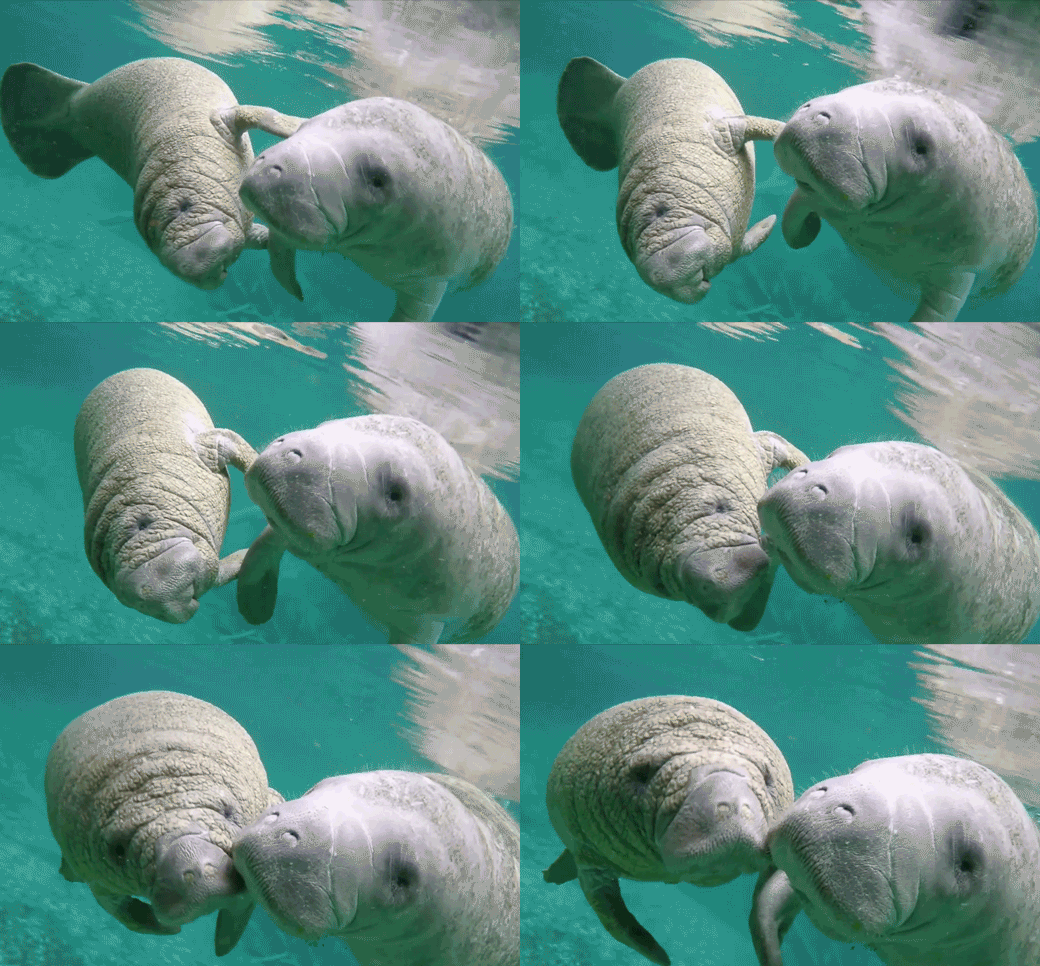
I will never forget the first time I saw a manatee. I was staying with my grandmother and with a wide smile over breakfast she told me she had a surprise for me. She took me to a park where the water was warm and the manatees floated serenely below. We were both silent for a long time, delighted to watch these incredible creatures up close. I was spellbound and allowed time to slow as I appreciated these wonders. Even though my grandmother sees these beautiful animals every week, her face matched mine with its look of awe.

It’s easy to see why manatees have entranced so many—these gentle giants and their cousins have inspired storytellers all over the world. Manatees belong to the order Sirenia, named because these creatures might have inspired the legend of the siren—a mythical being that enchanted sailors. Manatees occasionally stand on their tail which makes them look even more humanlike floating below the surface. Skeletons of manatees were even brought back to Europe as proof of the existence of mermaids.

Humans have been entranced by these incredible creatures far before the myth of the mermaid was first told. Dugongs, a cousin of the manatee, were found in a 3,000-year-old cave drawing in Palau where myths about young women transforming into these magical creatures have been passed down. Dugong is in fact a Malay word that means “lady of the sea.”

RyanM.Bolton.ShutterStock_Manatee_Email
© Ryan M. Bolton/Shutterstock

In West Africa, the manatee was inspiration for the legend of Mami Wata, a spirit of the sea and the mother of waters. Mami Wata is often depicted as a woman and, like a mermaid, she is half human, half fish. She brings good fortune to those who worship her. Manatees also play a role in the traditional religion of the Serer people of Senegal, the Gambia and Mauritania. They are considered the guardians of the secrets of the future. They also believe in Mindess, a female protector, who comes to humans in the shape on a manatee.

Manatees have inspired us for generations and remind me of the power and wonder of our ocean. I have never needed a manatee moment more than now to remind me to slow down and appreciate the incredible wildlife we have here on this planet. Sometimes all it takes is a single glimpse of one of the amazing creatures we are lucky enough to share the planet with to stop you in your tracks and fill you with wonder and awe.

Whenever I see a photo of the gentle face of a manatee it takes me back to that moment with my grandmother, entranced by these incredible animals. It connects me to the stories of humans throughout history who knew there was magic in our ocean and felt the call to protect it.

The post A Manatee Moment appeared first on Ocean Conservancy.


from Ocean Conservancy https://ift.tt/3kTHerL https://ift.tt/eA8V8J

Wednesday, 18 November 2020

5 Fabulous Facts About Hogfish

You’ve heard of catfish. You’ve heard of lionfish. And you’ve probably heard of frogfish, too.

But have you ever heard of hogfish? I certainly hadn’t, but as someone with the last name Hogge (yes, it’s pronounced like the animal), I knew once I learned about this adorably odd critter that I simply had to write about it. Fasten your seatbelts, friends, because I’m about to take you on a fact safari into the wild and wonderful world of Lachnolaimus maximus: the hogfish.

They’re named for their snouts.

Much like their nickname counterparts on land, hogfish have elongated snouts that earned them their namesake. This lengthy nose has a specific purpose: they’re specifically designed to help them forage for food. Hogfish absolutely love to snack on mollusks and crustaceans, and one of the best places to find them is buried in the sand at the seafloor. In a behavior known as rooting, they use their snouts to burrow into the sand and rummage around for these crunchy critters to munch on.

They can be pretty big fish.

These oval-shaped fish can vary in size, but are typically quite hefty, with larger individuals weighing up to around 22 pounds. To put that into perspective, that’s about the size of a dachshund, although there are some reports of hogfish that have been even bigger than that.

These fish have incredibly vibrant eyes.

hogfish
© Sander van der Wel / Wikimedia Commons.

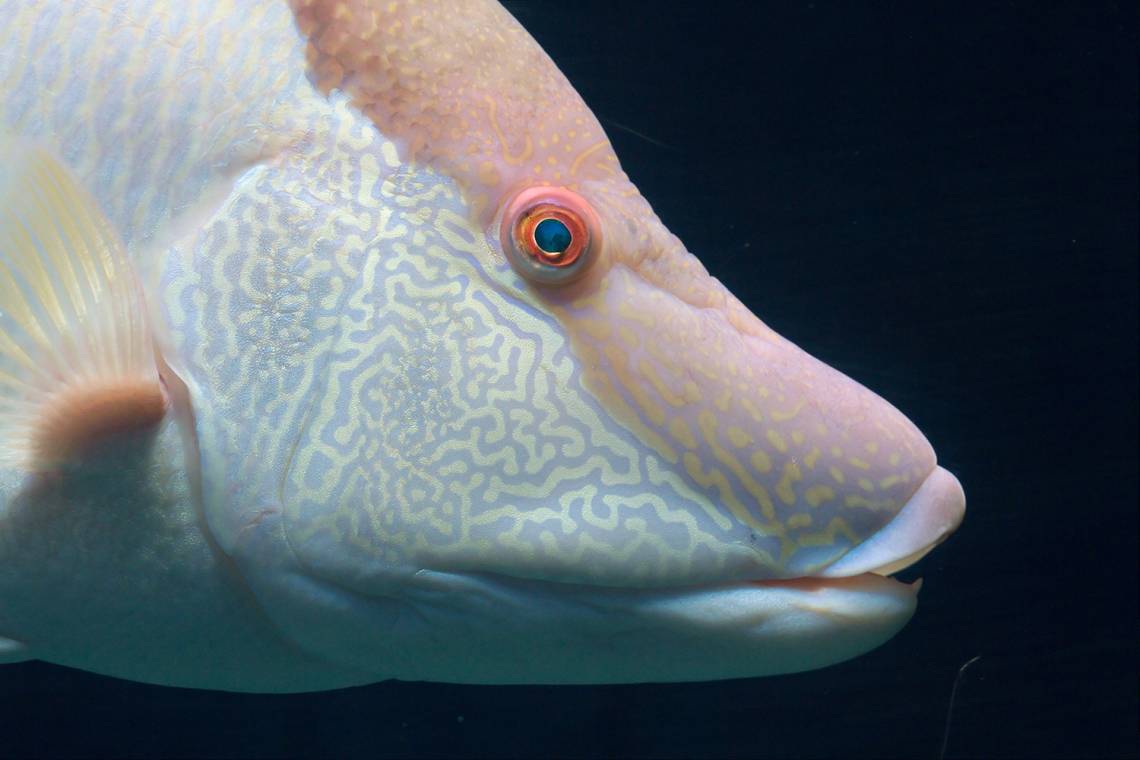
As you can see, hogfish are show-stoppers in the looks department, boasting quite vivacious coloration. Their appearance, however, is often variable depending on their age, sex and primary location. While they typically range in color from a reddish brown to a pale grey or yellow, there’s one trait about them that’s undoubtedly jaw-dropping: their eyes. With fiery-red irises, the eyes of these fish are truly a spectacle to observe.

Mostly all hogfish are females at birth.

Yes, you read that correctly! Here’s the deal: hogfish are what’s known as protogynous hermaphrodites, meaning that they have the ability to switch from female to male once they grow to be large enough. They’re also known to hang out in little polygamous groups, with a single male spending time with (and pursuing, if you will) multiple females.

They need our help.

Phillip Hamilton:Coral Reef Image Bank
© Phillip Hamilton/Coral Reef Image Bank
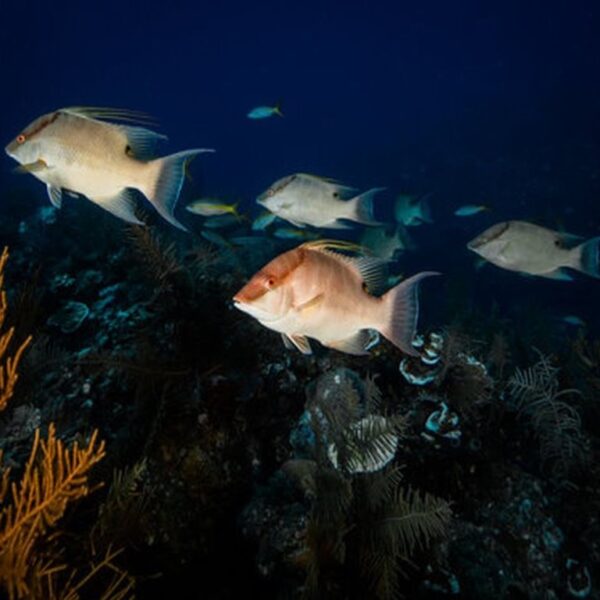
As marvelously charismatic as these fish are, they’re also overfished in part of their range, which extends from up to around North Carolina and Bermuda down to the northern tip of South America, as well as in and around the Gulf of Mexico and Caribbean Sea. Fishery managers in the U.S. have implemented management measures for fishermen seeking to catch hogfish, and there is a rebuilding plan in place to bring the overfished stock back to healthy levels. Today, you can help make sure that hogfish and other vulnerable species are protected, replenished and well-managed for years to come. Be sure to visit our Sustainable Fisheries program page to learn all about our important work to conserve important marine resources and the gifts our blue planet provides us!

The post 5 Fabulous Facts About Hogfish appeared first on Ocean Conservancy.


from Ocean Conservancy https://ift.tt/2HdxoDd https://ift.tt/eA8V8J

Friday, 13 November 2020

These Creepy Ocean Creatures Are the Stuff of Nightmares

When it comes to the creatures that call our ocean home, the first that may come to mind are probably magnificent whales, slow-swimming turtles or countless fish species. But our ocean is home to a mind-blowing number of incredibly diverse species, and not all of them are quite as charismatic as the well-loved iconic animals we’ve come to associate most closely with the sea.

From the deepest trenches of the sea to intertidal zones just off our coastlines, there are some lifeforms thriving in our ocean that are anything but cute and charming. Ready to meet some of our blue planet’s creepiest critters? Here are some of the absolute most *spine-chilling* marine invertebrates that call our ocean home. Read on to learn about just four of these most spook-tacular specimens of the sea.

Skeleton Shrimp

When I first laid my eyes on a photo of a skeleton shrimp, my first thought that followed was simple: there simply could not be a more appropriate name for this chillingly skeletal specimen. I quickly changed my mind when I learned that they’re also sometimes called the “praying mantises of the sea,” which seems less sinister to me (but I digress). If you look closely, you’ll notice that these crustaceans have tiny yet incredibly strong claws, which they use to reach out and grab prey when they’re least expecting it. These amphipods are typically small, normally reaching no more than around an eighth of an inch to two inches or so. Their usual go-to foods are things like algae and detritus (particles of dead matter that fall to the seafloor). These tiny critters are chilling to look at on a magnified level. Don’t believe me? The footage above from National Geographic just may change your mind!

Sea Spider

When I first learned of these spiders of the sea (which aren’t actually even spiders), I of course expected them to look similar to the arachnids that walk on land … but I did NOT expect them to have bodies reminiscent of the horrifying spider monsters from Stranger Things. The appearance of these creatures isn’t the only thing about them that will take you aback. These arthropods have what’s known as a proboscis: a type of elongated appendage that they use to suck up their food, slurping up energy by “sucking” nutrient-packed fluids out of sea jellies, worms and more. If you said, “ick,” don’t worry, I think that’s probably most people’s reaction. Science can be incredibly impressive sometimes … but it can also be disgusting, too.

Zombie Worm

Zombie worms? Yes, you read that right, and I truly do not think there could be a more apt set of nicknames for these creepy little critters. Thriving in the deepest parts of our ocean, these invertebrates also go by the nickname “bone-eating worms,” because they quite literally have a very specific preference when it comes to food. It’s important to know that these little worms don’t actually consume bones, however. Here’s what a daily meal for them looks like: when a dead whale or carcass of another large animal falls from the upper water columns to the seafloor, these worms play a very specific and important role in the biological breakdown of the creature’s remains. When it’s time to eat, these creepy-crawlers perforate the surface of the deceased host’s skeletal remains, utilizing acids to penetrate the outer layers of the bone to access the lipids that reside within the bone marrow. While this form of consumption may seem absolutely horrifying at first, it’s important to remember the critical part these zombie worms play in the cycle of life within our ocean. They are uniquely designed to thrive on bones, ensuring that the natural process of decomposition not only takes its course in an effective and efficient manner but also in a way that provides sustenance to other life forms on our planet.

Bloodybelly Comb Jelly

If you’re ready to learn about a truly morbid marine species, allow me to introduce you to this spectacularly scary ctenophore.  As you can see, the bloodybelly comb jelly gets its name from its belly that’s reminiscent of—you guessed it—blood. With a deep crimson coloration and mesmerizing movements, this ctenophore drifts through the waters of our ocean with majestic (and slightly petrifying) grace. But don’t be fooled, friends, because these jellies are anything but gentle or benign. Dubbed by Monterey Bay Aquarium Research Institute (MBARI) as “voracious predators,” these comb jellies have seemingly unquenchable appetites, primarily feasting on a menu of copepods, young fish and the larvae of various marine species. They’ve even been known to consume some of their ctenophore cousins if they can manage to wrangle them, too! Another fascinating factoid: apparently, their deep red coloration is intended to mask the glow of any creatures they consume that may be bioluminescent, so as to not let other prey know that they’re dangerous. Sneaky, Mr. bloodybelly comb jelly. VERY sneaky.


Well, friend … which of these creatures creeped you out the most? For me, it was definitely the sea spider! While so many of these species may send chills up your spine, don’t forget that every single one of these animals plays a special and important role in the delicate balance of life within the sea. Interested in learning more about the wild, wonderful (and somethings weird) life forms that call our ocean home? Be sure to follow along with us on Facebook, Twitter and Instagram with all sorts of fun facts about our blue planet.

The post These Creepy Ocean Creatures Are the Stuff of Nightmares appeared first on Ocean Conservancy.


from Ocean Conservancy https://ift.tt/35qMfTW https://ift.tt/eA8V8J

Thursday, 12 November 2020

Skating on Thin Ice in the Arctic

As each day’s headlines clamor for our attention, it’s hard to know what to focus on. But sometimes there is a signal so strong it can’t be ignored amidst the noise.

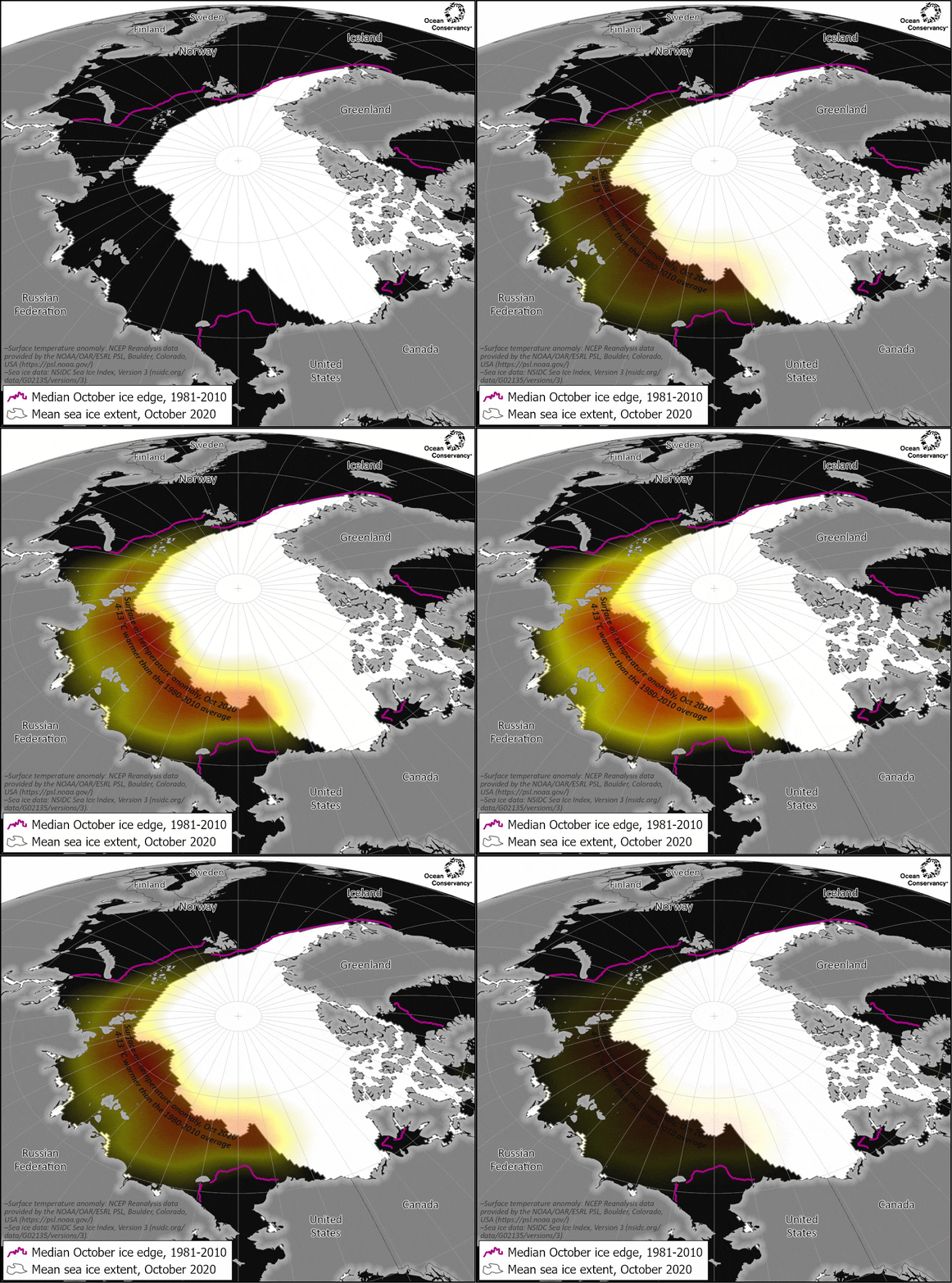
This year, for the first time in recorded history, the main nursery of Arctic sea ice off Siberia has not yet frozen as of early November. The Laptev Sea in the Russian Arctic is key to annual ice formation across the northern pole. Ice formed in the Laptev Sea typically feeds the system by transporting nutrients westward for Arctic plankton, which in turn supports the fish and marine mammals farther up the food web.

Gif showing correlation between temperatures and sea ice extent in the Siberian Arctic
Mean Arctic sea ice extent for October, 2020. The magenta line shows the median extent of sea ice from 1981-2010, and visibly brackets this year’s vast area of open water in the Siberian Arctic. The animated temperature overlay shows the strong overlap between this year’s abnormally warm surface air temperatures and the lack of sea ice formation for the same month.

Thin or late ice formation is unfortunately becoming the new norm. Average ice thickness in the Arctic is 50% of what it was in the 1980s. With ice loss, the ocean absorbs more solar radiation, global warming is amplified, circulation patterns shift and food webs are altered. From the smallest to the biggest, from phytoplankton to Indigenous people, sea ice loss is making it difficult to find food and survive in the Arctic Ocean.

The mechanisms for the delayed freeze this fall are clear. Northern Siberia experienced a record-breaking heatwave in 2020. From January to June, temperatures in northern Russia were more than 5° Celsius/ 9° Fahrenheit above average (and peaked at a record high of 38° Celsius / 100° Fahrenheit). The Arctic system is struggling to cope with the residual heat. Through a process called “Atlantification,” warmer Atlantic water is creeping to the surface in Arctic waters and melting the ice further.

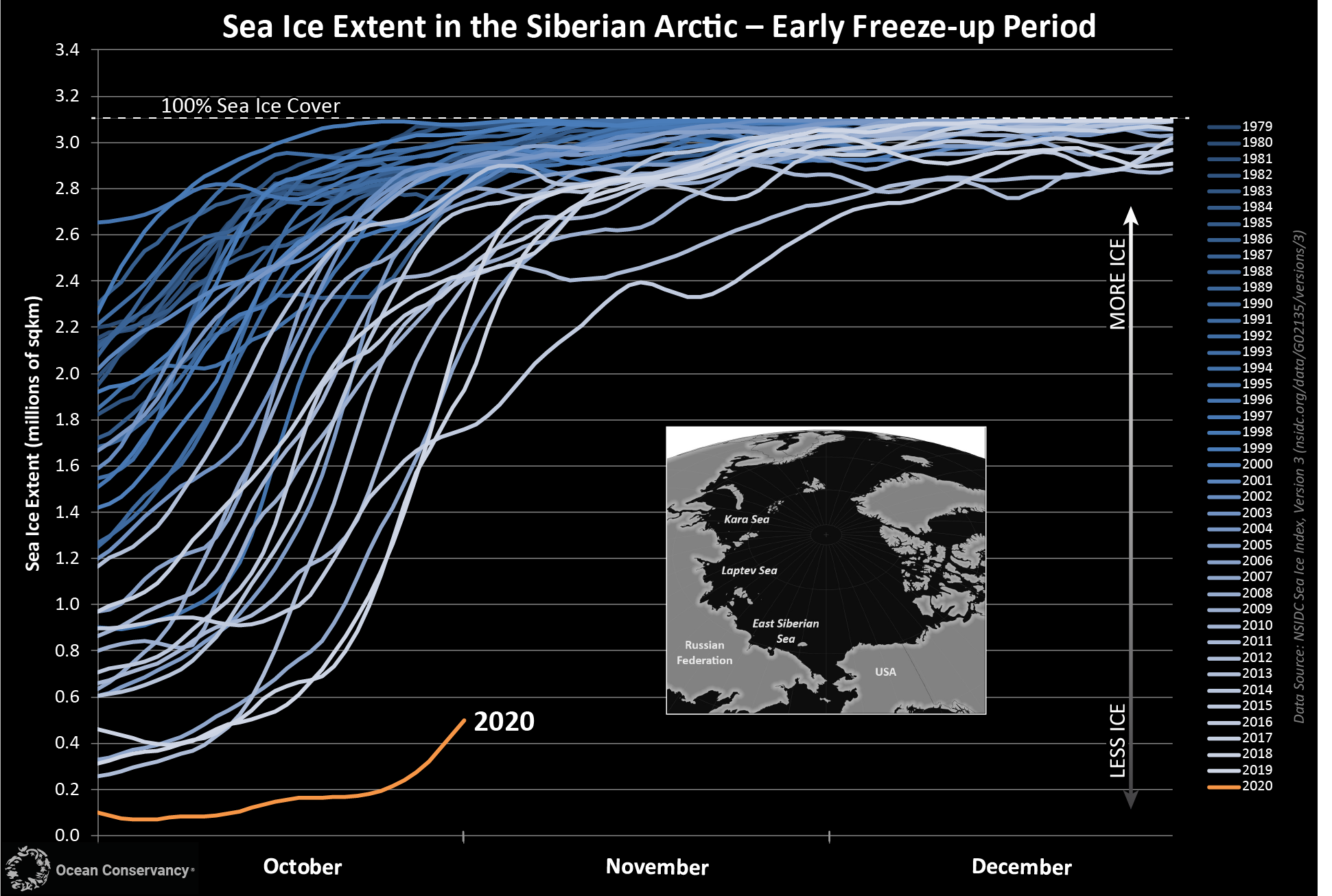
Graph showing the sea ice extent of the Siberian Arctic with a decrease in sea ice decline over recent years.
This graph shows sea ice extent during the early ice formation months of October, November and December by year in the Siberian Arctic. As indicated by the orange line, sea ice formation in 2020 lagged considerably behind all other years in the time series. The Siberian Arctic is comprised of the East Siberian, Laptev and Kara seas, as shown in the inset map.

2020 has been rough. If this year has taught us anything, it’s that we will continue to see surprising changes and disruptions near and far. These changes can happen quickly. At home, we may respond by simplifying our lives to minimize additional stresses. We take control of what we can. Reducing our carbon footprint contributes directly to global greenhouse gas emission reductions. Responsible consumption supports sustainable seafood and reduces trash going into our ocean.

We must do the same for the Arctic. When sea ice and the food web are shrinking, we must minimize cumulative stresses we are putting on the Arctic ecosystem by putting precautionary measures in place to manage shipping, fishing and offshore oil and gas activities. We should follow the lead of Indigenous people protecting their lands, waters and cultures. We cannot control everything, but we must take action wherever we can make a difference.

In short, our choices can give the Arctic a fighting chance to stay abundant and resilient to protect our planet and homes for future generations.

For additional details and media coverage on this topic, here are some useful references:

Russian Arctic Sea Fails to Freeze | The Moscow Times

Climate change made Siberian heatwave 600 times more likely – study | The Guardian 

Arctic amplification is caused by sea-ice loss under increasing CO2 | Nature Communications

Ocean Waves in November—in the Arctic | National Snow & Ice Data Center

The post Skating on Thin Ice in the Arctic appeared first on Ocean Conservancy.


from Ocean Conservancy https://ift.tt/3eSoMhs https://ift.tt/eA8V8J

Tuesday, 10 November 2020

The Wolffish is Weird-Looking and Wonderful

Think about wolves. Are you picturing fierce, powerful, majestic animals that lope gracefully through the landscape?

Wolffish are … not like that. Think less Call of the Wild and more Nightmare Before Christmas.

They might not be as classically captivating as their terrestrial namesakes, but they are still very cool critters. Today we’re taking a deeper look at these one-of-a-kind fish.

The name “wolffish” can refer to any one of five species in the family Anarhichadidae, which includes the wolf-eel and the Atlantic, spotted, Bering and northern wolffish. The scientific name for the Atlantic wolffish contains lupus, which is the Latin word for “wolf.” The largest species is the wolf-eel, which can grow to more than seven feet long.

The family name comes from the Greek word anarrhichesis, which means “to climb,” but these animals are typically pretty sluggish. That is partially because they live in cold, deep waters that slow their metabolism down and make it harder to make fast movements. Wolffish are found in the northern Atlantic and Pacific oceans at depths up to 2,000 feet. They like to hide out in nooks and crannies of rocky outcrops on the ocean floor.

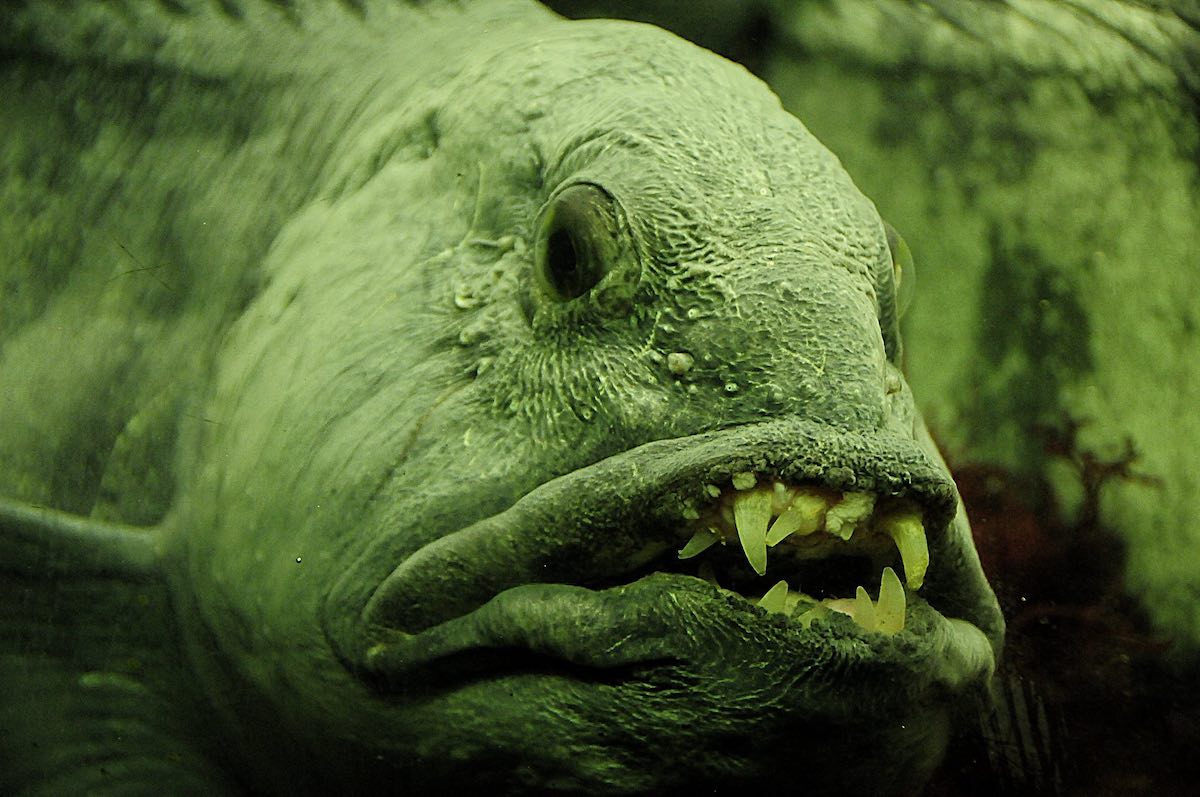
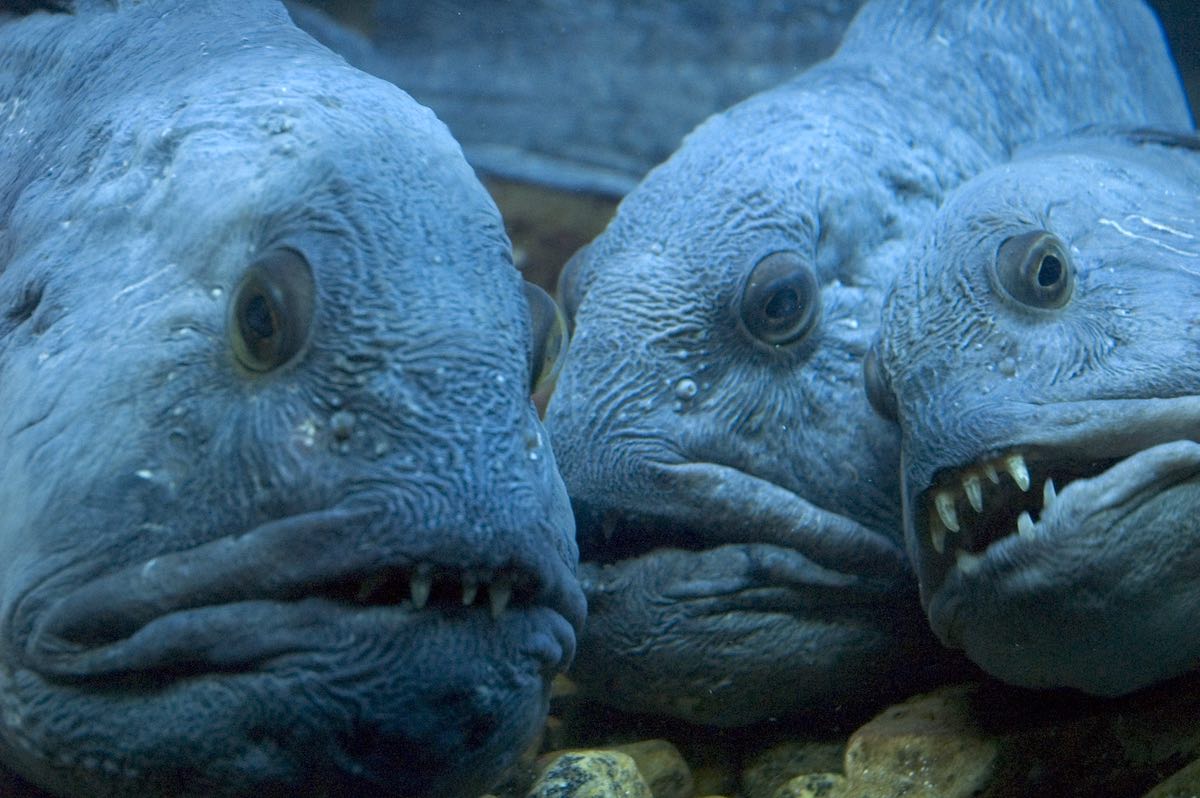
Wolffish have one main thing in common with wolves: they have sharp teeth and strong jaws that help them rip apart their prey. Their teeth are so prominent that some poke out their mouths (picture a vampire in need of braces). They use these chompers to dig into the sediment for food and to break apart the hard shells of clams, urchins, crabs and more. Other than their sharp teeth, you can recognize them by their long, eel-like bodies.

wolffish teeth
© Kamil PorembiƄski / Flickr

Wolffish have another trick up their sleeves (fins?) to survive in cold waters. They produce a special antifreeze protein that lowers the freezing point of the fluids in their bodies. These proteins bind to small ice crystals and prevent them from growing in the wolffish. One study showed that wolffish species that stay in shallower waters have five times the antifreeze proteins than their deep-sea wolffish relatives because shallow-water habitats are more likely to freeze.

If you weren’t impressed with the wolffish enough: they are dedicated parents, too! They typically live alone, but during breeding season they form bonded pairs to reproduce (some are even thought to mate for life). Females will lay thousands, or even tens of thousands, of eggs, then both the male and the female defend the eggs until they hatch. The offspring take a long time to develop, and often don’t reach sexual maturity until they are five years or older. The spotted wolffish, for example, isn’t ready to mate until they are seven!

Wolffish may not be the prettiest fish in the sea, but there is much more to them than meets the eye. Want to learn more about weird and wonderful fish? Check out the red-lipped batfish, the frogfish and the gulper eel!

wolffish
© Gaellery / Flickr

The post The Wolffish is Weird-Looking and Wonderful appeared first on Ocean Conservancy.


from Ocean Conservancy https://ift.tt/35gRgyv https://ift.tt/eA8V8J

What are Tire Wear Particles?

What do you think about when you hear the words “microplastic pollution?” Your mind may immediately go to imagery of colorful fragmented pl...