Thursday, 20 November 2025

See-Through Ocean Animals

From superheroes to myths and legends, humans are fascinated by creatures whose appearance helps them move through the water with stealth. From shape shifters to massive predators, all ocean creatures have abilities that help them navigate the open seas. Meet five incredible see-through animals you can find in our ocean—if you can spot them.

Chirodotid sea cucumber

Sea cucumbers come in a variety of shapes and colors, including a transparent species, the see-through sea cucumber. This chirodotid sea cucumber stands out from the crowd by blending in with its almost completely transparent body.

Not much is known yet about this tiny invertebrate. It was first observed in 2020 during a deep-sea exploration in the Pacific Ocean conducted by the National Oceanic and Atmospheric Administration (NOAA). Scientists hope that more research could reveal it as a new species. It likely feeds off small crustations on the sea floor. Documenting marine life helps people and scientists advocate for policies that keep our deep ocean biodiversity thriving.

Piglet squid – Cranchiidae

The piglet squid is another micro see-through creature that has stolen hearts with its adorable “snout-like” mouth and large cartoonish eyes. Like the sea cucumber, the piglet squid lives in deep waters, at least 2000 fee or more below the surface, and feeds off small crustaceans. The piglet squid has been spotted in the South Pacific, but research is needed to understand more about its habitat and the role it plays within the vast deep-ocean ecosystem.

Crocodile icefish – Channichthyidae

The crocodile icefish stands out even among the see-through crew of the ocean as the fish is the only vertebrate with colorless blood. This 10- to 20-inch predator uses its stealth to ambush its prey. A crocodile icefish will target marine animals up to half its size, attacking with lightning speed and pulling its victims into the cloudy sea floor.

The crocodile icefish takes being see-through to new heights because this fish not only has a transparent body, but even its blood is colorless. A lack of hemoglobin means that this fish’s blood carries less oxygen. To save oxygen, the crocodile icefish remains as still as possible until ambushing prey in the cold Antarctic waters.

Get Ocean Updates in Your Inbox

Sign up with your email and never miss an update.

This field is hidden when viewing the form
Name(Required)
By providing your email address, you consent to receive emails from Ocean Conservancy.
Terms & Conditions and Privacy Policy


This field is hidden when viewing the form
Email Opt-in: Selected(Required)

Sea angel – Clione limacina

These see-through mollusks are as lethal as they are beautiful. Clione limacina shape-shifts into a more biblically accurate angel when it hunts, extending its razor-sharp tentacles to relieve prey of its protective shell and swallow it whole.

Sea angels are kinds of sea snails that have just as much variety as sea cucumbers. The see-through sea angels are called clione limacina. This particular sea angel’s meal of choice is another graceful mollusk, the sea butterfly. While this sea creature can be found all over the world in mid-zone waters as deep as 2000 feet, scientists are still mapping the range and depth of its habitat.

Barreleye fish – Macropinna microstoma

No list of see-through ocean creatures is complete without the iconic barreleye fish. This otherworldly fish has a see-through head and large eyes that help it scan for prey above. These large globe-like eyes, within a larger transparent domed head, rotate forward when the barreleye fish has made a catch. Scientists discovered about 15 years ago that barreleye fish can rotate their eyes.

The barreleye fish can reach up to six inches long and lives in the deep ocean. Although they have been documented for decades, the rarity of these alien-like fish maintains their celebrity. The barreleye fish has been spotted only about a dozen times over the last 30 years.

Our strange and wonderful ocean

Our ocean is truly a fascinating and wonderful place with creatures that are stranger than fiction. The marine life that keeps our ocean balanced and healthy relies on all of us as scientists, advocates and ocean lovers to speak up for them and keep their habitats clean.

That’s why Ocean Conservancy continues to fight for our ocean through comprehensive approaches that build international and domestic support for a clean, healthy ocean—and everything that lives within it.

The post See-Through Ocean Animals appeared first on Ocean Conservancy.


from Ocean Conservancy https://ift.tt/f06sxUT https://ift.tt/t3Xs5kC

Wednesday, 19 November 2025

Does Eating Plastics Really Kill Ocean Animals?

The ocean has long been the end of the pipe for plastic pollution, with ocean wildlife bearing the brunt of the overproduction and overconsumption of single-use plastics. The world now produces more plastics than at any point in history—hundreds of millions of tons each year—and more than 11 million metric tons are flowing into the ocean annually. That is equivalent to more than a garbage truck’s worth of plastics entering our ocean every minute.

How does plastic kill ocean animals?

When swallowed, these plastics can be deadly—causing blockages, twisting organs or even puncturing organ walls. Ingested plastics have been found in nearly 1,300 ocean animal species, including every family of mammals and seabirds, and all seven species of sea turtles. Concern about the ecological implications of plastic-induced death rates has fueled calls for policy solutions at every level of government, from the local to the international. However, it is hard to set policy goals without understanding the measurable risk plastic ingestion poses to these species.

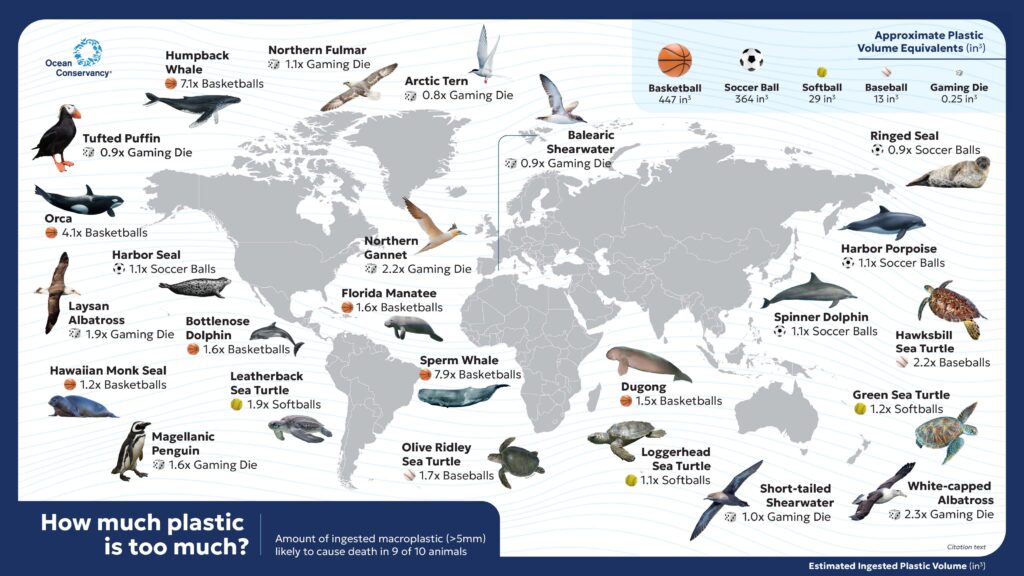
Ocean Conservancy scientists, along with top researchers at the University of Toronto, Federal University of Alagoas in Brazil and the University of Tazmania, worked together to answer the question: how much plastic is too much? They sought to determine how much ingested plastic is likely to cause death in seabirds, sea turtles and marine mammals. In other words, we sought to figure out the actual number of pieces and volume of macroplastics (plastics greater than 5 milimeters) that those animals must have in their gut to cause death 90% of the time.

Get Ocean Updates in Your Inbox

Sign up with your email and never miss an update.

This field is hidden when viewing the form
Name(Required)
By providing your email address, you consent to receive emails from Ocean Conservancy.
Terms & Conditions and Privacy Policy


This field is hidden when viewing the form
Email Opt-in: Selected(Required)

How much ingested plastic does it take to kill an ocean animal?

We compiled data from more than 10,000 necropsies—animal autopsies—of seabirds, sea turtles and marine mammals collected between the years 1900 and 2023 where we knew both the cause of death and whether and how much plastic the animal had eaten.

The results were alarming. We were surprised by the very small amount of plastic it takes to kill a seabird. We found that rubber (the kind balloons are made from) is the deadliest form of plastic to seabirds when ingested. It only takes six small pieces of rubber—each, on average, smaller than a pea in size—to kill a seabird.

Sea turtles are also surprisingly vulnerable, given their massive size: Less than half a baseball’s worth of plastics is likely to kill one in two Loggerhead turtles. Shockingly, nearly half of all sea turtles in our database had plastics in their guts at their time of death, which is especially troubling when you consider that five of the world’s seven sea turtle species are International Union for the Conservation of Nature (IUCN) red-listed as threatened.

Our models found that marine mammals are especially vulnerable to the impacts of lost fishing debris, also known as ghost gear; when swallowed, with just 28 pieces—each smaller than a tennis ball—enough to kill a sperm whale. Additional key findings from our research for each of the animal groups we studied include:

  • Seabirds
    • About 35% of seabirds in our dataset had plastic in their digestive tracts.
    • Roughly 5% of seabirds who had plastics in them died specifically from plastic ingestion.
    • Hard plastics were consumed more frequently than all other material types, followed by soft plastics, fishing debris, rubber and foams.
    • When a seabird consumes only three pieces of rubber, like balloon shreds, our models predict there is a 50% chance this consumption will lead to the animal’s death.
  • Marine Mammals
    • In marine mammals, fishing debris was the most frequently ingested plastic material, followed by soft plastics, rubber, hard plastics, foam and cloth.
    • Roughly 12% of marine mammals in our dataset had plastic in their digestive tracts.
    • Nearly 6% of marine mammals from our dataset with plastics inside died as a result of eating those plastics. 
    • When a marine mammal consumes just 12 pieces of soft plastic—like grocery bags—our models predict a 50% chance this action will lead to the animal’s death.
    • Half a soccerball’s worth of soft plastic (by volume) is enough to kill 90% of individuals in most seal, sea lion, dolphin and porpoise species. 
  • Sea Turtles
    • In sea turtles, soft plastics like grocery bags were found to be the most frequently ingested plastic material, followed by fishing debris, hard plastics, foams, rubber and cloth.
    • Nearly 50% of individual sea turtles in our dataset had plastic in their digestive tracts
    • About 9% of turtles that ingested plastic in our dataset died as a result of eating it. 
    • Over 4% of all turtles in our dataset died directly from plastic ingestion. 
    • Just 1.5 golf ball’s worth of plastic (by volume) is enough to kill 50% of adult loggerhead sea turtles.

What can this research do?

This research emphasizes the risks macroplastic pollution poses to the life of marine animals, and the risk varies by species and plastic type. Our findings provide key insights to inform future research and policy actions aimed at reducing plastic pollution and the harm it causes to ocean wildlife and ecosystems. These results also underscore that important interventions like beach cleanups and better management of plastic waste are critical for protecting marine species. Because some types of plastics are deadlier than others when swallowed by marine life, policies targeting those specific items (e.g., plastic bags and balloons) can play an important role in protecting vulnerable species from the harms of plastic pollution in the future.

It is imperative to tackle the global plastics crisis by taking actions at all levels, from local to federal to international. In the U.S., bills like the REUSE Act—bipartisan legislation that would require examination and enhancement of existing reuse and refill systems—is just one way to make a difference. Add your name now and call on lawmakers to support and pass the REUSE Act.

Map of sea turtles, seabirds and marine mammals depicting the amount of ingested plastic that would cause death in 9 of 10 individuals, based on our models. It does not suggest that all of these species DO ingest plastic, as some have not been studied for it directly; rather, it shows that IF plastics are ingested, these amounts would likely lead to the animal’s death

The post Does Eating Plastics Really Kill Ocean Animals? appeared first on Ocean Conservancy.


from Ocean Conservancy https://ift.tt/E5TWO3N https://ift.tt/ojRkISh

Wednesday, 12 November 2025

Climate Finance Goals for Our Ocean at COP30

The world is fast approaching another decisive moment. With world leaders meeting right now (November 10-20) in Belém, Brazil, for COP30, they have the chance to elevate our ocean as a climate solution. That is why one of Ocean Conservancy’s key objectives at COP30 will be to unlock ocean finance by working to establish a Blue Finance Window within the United Nations Framework Convention on Climate Change (UNFCCC), the body responsible for improving how climate finance is coordinated, tracked and delivered. This would essentially provide the financing architecture needed to direct major climate funding toward ocean-climate solutions at scale.

Without bold action, coastal communities, marine ecosystems and national economies will continue to face growing climate pressures. The cost of inaction will dwarf the price of smart investments to strengthen resilience and protect livelihoods.  

Why is ocean finance under-resourced? 

Part of the challenge is structural. Funding for the ocean is scattered across development agencies, ministries, philanthropy and private investors—often without shared priorities, definitions or even a clear understanding of what counts as “ocean-climate finance.” This confusion obscures the true scale of underinvestment, making it nearly impossible for coastal nations and Small Island Developing States to access finance quickly and at scale. As a result, estimates of what is needed to support a sustainable ocean economy range widely, from $383 billion to $717 billion per year.

Get Ocean Updates in Your Inbox

Sign up with your email and never miss an update.

This field is hidden when viewing the form
Name(Required)
By providing your email address, you consent to receive emails from Ocean Conservancy.
Terms & Conditions and Privacy Policy


This field is hidden when viewing the form
Email Opt-in: Selected(Required)

Why is ocean finance important? 

The ocean is continuously treated as an afterthought in global climate policy and finance. Despite its central role, ocean-based climate solutions receive less than 2% of global climate finance, reflecting a staggering imbalance between the ocean’s importance and the world’s investment in its future. Our ocean feeds us, regulates our climate and produces half of the oxygen we breathe. It sustains more than 350 million jobs and supports an economy worth an estimated $3 trillion every year. There is no climate stability, no food security and no global prosperity without a thriving ocean. 

A Blue Finance Window: one practical step to ocean finance 

Ocean Conservancy and our partners are calling for a “Blue Finance Window” within the UNFCCC climate-finance architecture. A Blue Finance Window would be like a separate account just for the ocean and would ensure that money is earmarked specifically for ocean-climate projects.

A Blue Finance Window would give countries a clear, predictable and scalable mechanism to access finance for ocean-climate solutions. It would also make finance easier to track, coordinate and unlock at scale, helping close the gap between ambition and implementation. 

Ocean finance has an opportunity to shine at COP30

Momentum is finally shifting. The COP30 presidency sent the strongest signal yet, declaring ocean-climate projects are under-resourced and that countries and partners should work to unlock a Blue Finance Window to unlock sustained ocean-finance investments. 

This message matters. It shows that ocean finance is no longer a side conversation. It is becoming a core pillar of the COP30 agenda and of the climate finance system itself, something that Ocean Conservancy has continuously championed.  

COP30 presents a rare opportunity to transition from a patchwork of isolated projects to a truly coordinated ocean-finance system. Rather than continuing with fragmented efforts that will never meet the scale of the crisis, countries can build a fit-for-purpose mechanism that matches the power of ocean solutions with the urgency of the moment. 

Take action 

You can help Ocean Conservancy fight for a Blue Finance Window and other ocean-climate solutions at COP30 and beyond. Add your name in support of ocean-climate action now. 

The post Climate Finance Goals for Our Ocean at COP30 appeared first on Ocean Conservancy.


from Ocean Conservancy https://ift.tt/Mpx94oE https://ift.tt/U6dhYbB

Monday, 10 November 2025

Ten Animals Impacted by Ghost Gear

Lost and abandoned fishing gear, commonly known as “ghost gear,” is the most harmful form of marine debris to wildlife. Commonly made from modern plastics, such as nylon or polyethylene, fishing gear is designed to capture the seafood that ends up on our plates.

No fisherman ever wants to lose their gear—it’s expensive, and the means by which they harvest seafood to feed their families and the rest of the world. But when the gear is lost—whether through entanglement on a rocky sea floor or an unexpected storm that blows fixed gear off course—the gear can continue to capture and entangle wildlife, even while no longer in use.

Fortunately,  Ocean Conservancy’s Global Ghost Gear Initiative (GGGI) works alongside fishermen and global experts to find solutions to this global problem. This year, we are celebrating our 10-year anniversary of the GGGI. Dive in to see how ghost gear might affect your favorite marine species:

1. Fish

The most obvious animal impacted by lost fishing gear—fish. Estimates vary by species and fishery, but one assessment of Norwegian Greenland Halibut found that stocks declined by as much as 30% annually due to the impact of ghost gear. That means 30% fewer fish for fishermen to harvest, leaving them with less money in their pockets and leaving people with less food accessibility.

2. Lobster

In the United States and Canada, most lobster traps are made from metal coated with Polyvinyl Chloride (PVC)-coated metal, a synthetic plastic polymer known for its durability and affordability which is designed to last in harsh marine conditions. A lost lobster trap can continue to trap lobsters and other species for an indefinite amount of time; this happens when a trapped lobster dies, thus becoming the bait for more hungry creatures. Many fisheries—including the American Lobster fishery in Maine—require an “escape door” that activates after a set amount of time to allow animals to escape if the trap is lost, a best practice for reducing the impact of lost fishing gear. However, if the door is too small or doesn’t activate, lobsters and other animals can still get caught. GGGI has worked with lobster fisheries in Mexico, Canada, the Caribbean and the U.S. to trial new technologies that aim to reduce the impact of lost lobster traps.

Get Ocean Updates in Your Inbox

Sign up with your email and never miss an update.

This field is hidden when viewing the form
Name(Required)
By providing your email address, you consent to receive emails from Ocean Conservancy.
Terms & Conditions and Privacy Policy


This field is hidden when viewing the form
Email Opt-in: Selected(Required)

3. Birds

Birds may not be the first animals that come to mind when you think of the ocean, but seabirds are important marine species providing a crucial link between air and sea. In a survey of 5,000 derelict fishing nets removed from the Puget Sound, researchers tallied 25,000 birds among the ensnared animals. This is because seabirds often flock to fishing vessels attracted to the bait meant for fish. Fortunately, fishermen understand that keeping birds away from their bait is in their own economic interest, and many solutions (including streamer lines or line weighting) have been developed to help keep birds safe from active fishing gear.

4. Crabs

Similar to lobsters, crabs are typically caught using large traps that sit on the sea floor. If lost, the traps can continue to capture commercially important species, impacting fishermen and people who depend on seafood as an important food source. In the Chesapeake Bay, there are an estimated 145,000 derelict crab pots, which kill approximately 6 million crabs, 3.5 million white perch and 3.6 million Atlantic croaker annually. But researchers at the Virginia Institute of Marine Science have shown that efforts to remove derelict pots have increased harvests around the Bay and put an extra $33.5 million in the pockets of Bay crabbers.

5. Sharks

Among the ocean’s top predators, healthy shark populations are essential for a healthy ocean. That’s why in 2013, scientists were stunned to find a “major, previously unknown source of shark mortality: entanglement in drifting fish aggregating devices (FADs),” many of which  dangle netting in the water column to attract fish. This study found that the number of entanglement deaths for silky sharks is likely similar to the actual allowable catch for these sharks. Basically, these entangling FADs are catching as many silky sharks as fishermen, essentially doubling the number of sharks impacted each year. This has major implications for the conservation of this species.

6. Whales

The International Whaling Commission estimates that more than 300,000 whales and dolphins die annually as a result of bycatch and entanglement in fishing gear, including both lost and actively deployed gear. In the U.S. alone, 95 large whales were confirmed entangled in 2024, including bowhead, fin, humpback, gray and North Atlantic right whales. Whale entanglements can also have disastrous financial consequences for fishermen who lose expensive fishing gear as it is dragged away by the large marine mammals.

7. Vaquita porpoises

With just 10 individuals left in the wild, vaquita are the most endangered marine mammal in the world. Their decline is largely due to the use of illegal gillnets when targeting totoaba—a fish highly valued on the black market—in the northern Gulf of California in Mexico. Large-scale international conservation efforts have been made to save the vaquita through the removal of thousands of gillnets and the creation of a marine reserve, but the future of the vaquita remains uncertain, especially as the area opens up to fishing again.

8. Sea Turtles

Five out of seven species of sea turtles are considered threatened or endangered according to the International Union for Conservation of Nature (IUCN) Red List of Threatened Species, so it should be especially concerning that turtles are among the species most at-risk of bycatch and entanglement in ghost gear. A 2014 study identified more than 1,000 cases of stranded sea turtles involving fishing gear entanglement from 1997 to 2009 in Florida alone. However, efforts are being made in many global fisheries to protect turtles from bycatch, including requiring turtle excluder devices in trawl fisheries and trialing biodegradable materials for use in fish aggregating devices.

9. Seals

Much like the other species on this list, pinnipeds like seals and sea lions are also at risk of entanglement from fishing gear. Their curious nature means they sometimes approach lost gear to get a closer look, often ending up entangled. A 2024 study looking at Hawaiian monk seals found that plastic fishing gear components accounted for 76% of the items entangling the animals. Accumulations of abandoned fishing gear on land can also impact breeding behavior when it occurs in areas of critical habitat.

10. Corals

They may look like plants or rocks, but don’t be fooled—corals are animals.  Corals perform several important functions in the ocean and are especially important for coastal economies that depend on tourism dollars from divers, snorkelers and beachgoers. Nets and lines can damage a fragile reef’s structure by breaking off coral heads. This not only reduces reefs’ ability to support biodiversity but also disrupts food chains and limits them in performing other critical ecosystem support functions like protecting coasts from storm surges and contributing to nutrient cycling. Studies confirm increasing levels of broken coral, decreased coral cover and lower species diversity in areas where ghost gear is common.

But here is the good news: After 10 years working on this issue, the GGGI has many reasons to be hopeful. Chief among them is that there are solutions to this problem, and we’ve found a global community of fishermen, scientists, policymakers and ocean lovers who are eager to help us implement them. While this issue remains a pervasive threat to our ocean and the communities that rely on it, we’re inspired by the momentum that’s been created by our partners over the past 10 years. Learn more about our GGGI work here and join the movement to protect our ocean.

The post Ten Animals Impacted by Ghost Gear appeared first on Ocean Conservancy.


from Ocean Conservancy https://ift.tt/CE4SLIh https://ift.tt/yWBufTO

5 Animals That Need Sea Ice to Thrive

Today, we’re getting in the winter spirit by spotlighting five remarkable marine animals that depend on cold and icy environments to thrive....